

Jul-2026 Free Appian ACD101 Exam Question Practice Exams
Ace ACD101 Certification with 126 Actual Questions
Appian ACD101 Exam Syllabus Topics:
| Topic | Details |
|---|---|
| Topic 1 |
|
| Topic 2 |
|
| Topic 3 |
|
| Topic 4 |
|
| Topic 5 |
|
| Topic 6 |
|
NEW QUESTION # 38
Where can an Appian Developer connect with and share their expertise with other Appian Developers?
- A. Appian Learning Paths via Appian Academy
- B. Appian Community discussions
- C. Appian Knowledge Base
Answer: B
Explanation:
Appian Community discussions provide a platform for Appian Developers to connect with, share expertise, and learn from each other. The community is a vibrant space where developers can ask questions, share solutions, and discuss best practices related to Appian development. While Appian Learning Paths via Appian Academy and Appian Knowledge Base are valuable resources for learning and troubleshooting, the Community discussions specifically facilitate peer-to-peer interaction and knowledge sharing among developers.
Reference: Appian Community Website
NEW QUESTION # 39
Review the following code snippet:
index({"a", "b", "c"}, 1, "x")
Which value is returned?
- A. c
- B. a
- C. x
- D. b
Answer: C
Explanation:
The index() function in Appian is used to replace an element at a specified index in a list. In the code snippet index({"a", "b", "c"}, 1, "x"), the function is called to replace the element at index 1 of the list {"a", "b", "c"} with the string "x". Since Appian lists are 1-indexed, this means that the first element "a" will be replaced by "x". However, since the function is used to modify a list and not to return a value, if this function is used as is without being part of a larger expression that outputs the list, it would not return any of the listed values.
Reference: Appian Expression Language Documentation - Functions
NEW QUESTION # 40
While testing, the process consumes at least 2000 AMU of process memory for each instance.
What are four ways to reduce the overall memory footprint of your process instances? (Choose four.)
- A. Start the process with the memory optimizer option toggled "On".
- B. Compress text into a .ZIP file before storing them in process variables.
- C. Reduce the number of process variables. Most Voted
- D. Do not store large data chunks like text strings in process variables. Most Voted
- E. Split the process into subprocesses so that only a part of the overall process is active. Most Voted
- F. Reduce your process' delete and archival interval under Data Management > Automatic Process Clean- Up. Most Voted
Answer: C,D,E,F
NEW QUESTION # 41
Review the following expression rule:
union(ri!fruit, ri!vegetables)
The rule inputs are configured as text arrays.
What is the expected output?
- A. All items in ri!fruit and ri!vegetables combined, with duplicates removed.
- B. All items in ri!fruit followed by items in ri!vegetables, including duplicate values.
- C. Only items that are in both ri!fruit and ri!vegetables.
Answer: A
Explanation:
The union() function in Appian combines the elements of two or more arrays into a single array, removing any duplicate values. Given that the rule inputs ri!fruit and ri!vegetables are configured as text arrays, the expected output of union(ri!fruit, ri!vegetables) would be an array containing all unique items from both ri!fruit and ri!vegetables, with any duplicates removed. This function is useful for combining lists without repetition, ensuring a clean, unique set of elements.
Reference: Appian Documentation - Expression Functions
NEW QUESTION # 42
When applying a default filter to a record type, what is a true statement for excluded data?
- A. The data does not show up in the record list. End-users are unable to clear the filter condition to view the data.
- B. The data does not show up in the record list, but end-users can clear the filter condition to view the data.
- C. The data does not show up in the record list, but can be accessed by end-users using a direct link to a record view.
Answer: B
Explanation:
When a default filter is applied to a record type in Appian, the data excluded by that filter does not appear in the default record list. However, end-users with appropriate permissions can modify or clear the filter conditions to view the excluded data. This behavior allows for a flexible and user-driven data exploration experience within Appian record lists.
Reference: Appian Documentation - Record Lists and Filters
NEW QUESTION # 43
A user wants to view a bulleted list of information on an interface.
Which component should you use?
- A. paragraphField
- B. richTextDisplayField
- C. textField
Answer: B
NEW QUESTION # 44
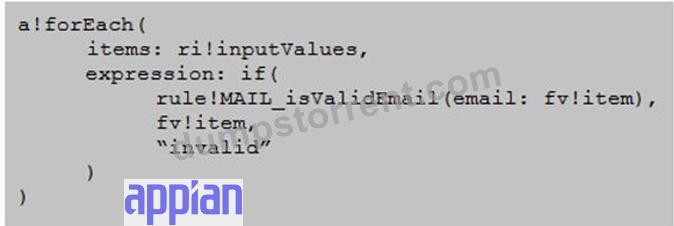
You want to replace any invalid email addresses in a list of email addresses with the word 'invalid'.
A rule already exists within your application which determines if an email address format is valid:
"MAIL_isValidEmail()". This rule takes in a single email address and returns either "True" or False".
Which code snippet will return the desired output?
- A.

- B.
- C.

Answer: B
NEW QUESTION # 45
You need to remove an unused field from an existing record type Product, which has data sync enabled and is backed by a database table.
What should you do?
- A. Delete the column from the database table and perform a full resync of the record type.
- B. Delete the field from the record type and optionally delete the column from the database table.
- C. Delete the field from the product Custom Data Type (CDT) and perform a full resync of the record type.
Answer: C
Explanation:
In Appian, when dealing with a record type that has data sync enabled and is backed by a database table, changes to the structure of the underlying data model, such as removing a field, should be carefully managed. The correct approach involves deleting the unused field from the Custom Data Type (CDT) that defines the structure of the data for the record type. Following this change, a full resynchronization of the record type is necessary to ensure that the changes in the CDT are reflected in the record type and its associated data in Appian. This process ensures data integrity and consistency across the application and the database.
Reference:
Appian Documentation on Data Management: Provides guidelines on managing data structures, including CDTs and record types, within Appian applications.
NEW QUESTION # 46
You built a grid field with the data source as a query entity.
You want to add a search box to the grid using Appian's out-of-the-box functionality. You set the parameter of showSearchBox to "True", but the search box is still not appearing.
Why is the search box NOT appearing?
- A. The grid is on an interface that needs to be placed within a report object.
- B. The showSearchBox parameter only applies when a record type is used as the source in the data.
- C. The search box only appears when data is populated in the grid.
Answer: B
NEW QUESTION # 47
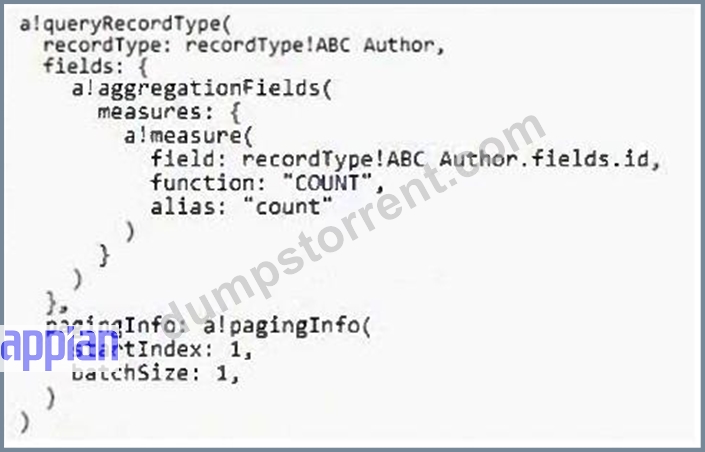
You have a record type, ABC_Author , backed by a database table.
You need to retrieve the total number of authors without loading all the data.
According to Appian best practices, which code snippet accomplishes this goal in the most efficient way?
- A.
- B.

- C.
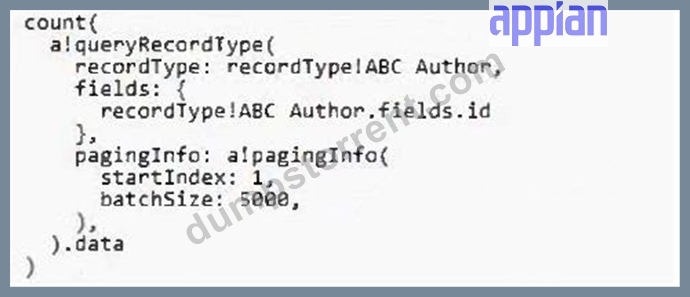
Answer: A
Explanation:
According to Appian best practices, the most efficient way to retrieve the total number of authors without loading all the data is to use a query that includes an aggregation function. Option B uses an aggregation field with a COUNT function, which is designed to return the number of rows that match a query without the need to retrieve and load all row data, thus optimizing performance.
References
* Appian Documentation: a!queryRecordType Function
NEW QUESTION # 48
You have a record action that should only be visible to certain users under conditions specified by an expression.
How should you configure this?
- A. Set security on the process model.
- B. Set permissions directly on the user object.
- C. Set security on the record action.
Answer: C
Explanation:
To control the visibility of a record action based on certain user conditions or expressions, the security settings of the record action itself must be configured. This involves defining conditions or expressions within the record action ' s security settings that evaluate whether a user meets the criteria to see and interact with the action. This method allows for dynamic control over the accessibility of actions based on user roles, specific attributes, or other contextual factors, ensuring that only authorized users can see and execute the action under specified conditions.
References:
Appian Documentation on Record Actions: Details how to configure and secure record actions, including visibility and permissions, to tailor the user experience within record views.
NEW QUESTION # 49
Review the following expression rule: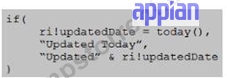
The updatedDate is of type "Date", and current datetime is 01/01/2023 5:00 PM GMT+00:00.
What is the output of this expression if the value of updatedDate was saved as today() one(1) hour ago?
- A. Updated Today
- B. Updated 01/01/2023
- C. Updated 01/01/2023 4:00 PM GMT+00:00
Answer: A
NEW QUESTION # 50
The "Create Vehicle" process model writes a new vehicle to the database using the Write to Data Store Entity smart service. You provide a null value for the primary key, and the database manages the primary key id as an auto-incremented integer.
You need the value of the primary key for the new vehicle to use later in the process model.
How should you get the value?
- A. Dot notate into the ID field of the process variable written to the database, which is automatically updated by the Write to Data Store Entity smart service.
- B. Add a script task to query for the most recently updated vehicle using loggedInUser().
- C. Reference AC!StoredValues in the Outputs tab of the Write to Data Store Entity node.
Answer: C
NEW QUESTION # 51
You have two Custom Data Types (CDT): ACME_invoice and ACME_invoiceItem that have a flat relationship.
The invoice item table has a field that is a foreign key to the invoice table. You are leveraging the database to automatically generate their primary keys.
How should you structure the process model to add a new invoice and the new invoice items to the system?
- A. 1. Write to Multiple Data Store Entities smart service (Writing to the ACME_invoiceItem table and ACME_invoice table).
- B. 1. Write to Data Store Entity smart service (Writing to the ACME_invoiceItem table).
2. Script Task to update foreign keys.
3. Write to Data Store Entity smart service (Writing to the ACME_invoice table). - C. 1. Write to Data Store Entity smart service (Writing to the ACME_invoice table).
2. Script Task to update foreign keys.
3. Write to Data Store Entity smart service (Writing to the ACME_invoiceItem table).
Answer: C
Explanation:
When dealing with related data types where one has a foreign key to another, you must first create the record in the primary table (ACME_invoice) and then use the generated primary key to create related records in the secondary table (ACME_invoiceItem). This is why you first write to the ACME_invoice table, then update the foreign keys in a Script Task, and finally write to the ACME_invoiceItem table.
Reference:
Appian Documentation: Relational Databases
NEW QUESTION # 52
Review the following expression rule: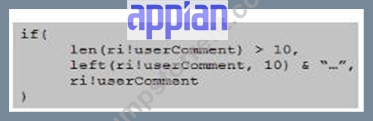
What is the expected output if ri!userComment is "0123456789ABC"?
- A. "0123456789ABC"
- B. "0123456789..."
- C. {"0123456789","..."}
Answer: B
NEW QUESTION # 53
After selecting a record, a user wants to initiate an activity in the context of that selected record.
You start by creating the process model that implements this activity.
What should you do next?
- A. Configure a site page as an action to kick off the process model.
- B. Add the process model as a record related action to that record.
- C. Add the process model as a record list action to that record.
Answer: B
Explanation:
a record related action. This allows the action to be performed in the context of a specific record, making it straightforward for users to initiate processes directly from the record view.
Reference:
Appian Documentation: Record Related Actions
NEW QUESTION # 54
You are working on a process model "VIM Update Vehicle."
You want to call another process "VIM Get Service Date" that accepts pv!vehicleId as a process parameter and sets a value for pv!serviceDate. The next node in VIM Update Vehicle depends on the value of pv!serviceDate.
Which node should you use to execute "VIM Get Service Date" from VIM Update Vehicle?
- A. Asynchronous subprocess with activity chaining
- B. Synchronous subprocess with input and output variables configured
- C. Start Process smart service
Answer: B
Explanation:
When a process model depends on the value of a variable being set by another process, a synchronous subprocess should be used. This ensures that the calling process (VIM Update Vehicle) will wait for the subprocess (VIM Get Service Date) to complete and set the necessary pv!serviceDate value before continuing. The subprocess node should be configured with input and output variables to pass the pv!vehicleId and receive the pv!serviceDate.
Reference:
Appian Documentation: Subprocess Node
NEW QUESTION # 55
You need to create a record type of only active Products using an existing database table: PRODUCT.
The PRODUCT table consists of the following columns:
* ID(INT(11))
* NAME (VARCHAR(255))
* DESCRIPTION (VARCHAR(1000))
* IS_ACTIVE (BIT)
* CREATED_BY (VARCHAR(255))
* CREATED_ON (TIMESTAMP)
* MODIFIED_BY (VARCHAR(255))
* MODIFIED_ON (TIMESTAMP)
What is a valid way to create this record type?
- A. Create a record type with data sync enabled using the PRODUCT table, and create a user filter using IS_ACTIVE.
- B. Create a record type without data sync enabled using the PRODUCT table, and apply record-level security to filter out inactive products.
- C. Create a record type with data sync enabled using the PRODUCT table, and apply a source filter on IS_ACTIVE to filter out inactive products.
Answer: C
NEW QUESTION # 56
Which code snippet calls the interface APP_RecordDashboard while following best practices for passing in values for " recordId " and " firstName " ?
- A.
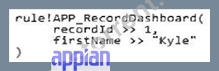
- B.
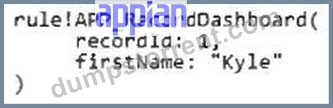
- C.

Answer: B
Explanation:
The best practice in Appian for passing values into an interface is to use named parameters, which is demonstrated by Option B. Named parameters make the code more readable and maintainable by clearly specifying which parameter each value is being passed to. In this case, the recordId and firstName parameters are clearly being assigned the values 1 and " Kyle " respectively.
References
* Appian Documentation: Passing Parameters to Interfaces
NEW QUESTION # 57
After selecting a record, a user wants to initiate an activity in the context of that selected record.
You start by creating the process model that implements this activity.
What should you do next?
- A. Configure a site page as an action to kick off the process model.
- B. Add the process model as a record related action to that record.
- C. Add the process model as a record list action to that record.
Answer: B
Explanation:
a record related action. This allows the action to be performed in the context of a specific record, making it straightforward for users to initiate processes directly from the record view.
References
* Appian Documentation: Record Related Actions
NEW QUESTION # 58
Match each Appian Design Object name to the most applicable use case.
Note: Each use case will be used once or not at all. To change your responses, you may deselect your response by clicking the blank space at the top of the selection list.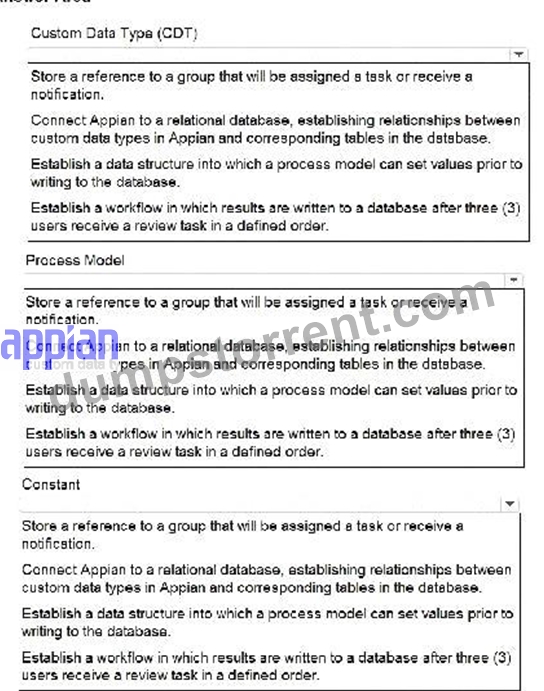
Answer:
Explanation: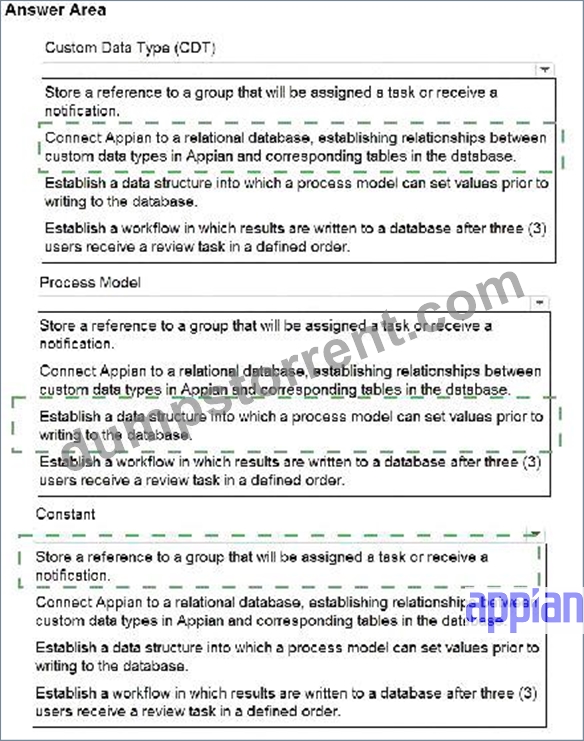
Explanation:
* Custom Data Type (CDT): Connect Appian to a relational database, establishing relationships between custom data types in Appian and corresponding tables in the database.
* Process Model: Establish a data structure into which a process model can set values prior to writing to the database.
* Constant: Store a reference to a group that will be assigned a task or receive a notification.
* Custom Data Types (CDTs) define the structure of data within Appian and can be mapped to existing database tables to leverage relational database functionalities. They establish how data is structured and stored in the Appian application.
* Process Models depict the workflow and logic of a business process. They can include user and automated tasks, and they can manipulate and store data before, during, and after the execution of the process.
* Constants are reusable static values that can be referenced within Appian. They can store values like group references, which can then be used for task assignment or notification purposes in process models or other expressions.
References
* Appian Documentation: Data Types, Process Models, Constants
NEW QUESTION # 59
While calling this rule in your interface, you receive the following error message: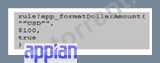
How could you have prevented this error from happening?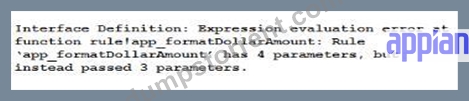
- A. Call the rule by using a local variable.
- B. Use the keyword syntax.
- C. Use Index().
Answer: B
NEW QUESTION # 60
You are creating a form used to order a pizz
a. You use a radio button component for the selection.
The pizza selection labels include a list of toppings. You do not want the selection labels to be truncated.
Which layout should you choose?
- A. Compact
- B. Stacked
- C. Grid
Answer: B
Explanation:
For a pizza ordering form where you do not want the radio button selection labels to be truncated, the Stacked layout is the most appropriate. This layout will list the options vertically, giving each one adequate space and preventing truncation, which is particularly useful when the labels include longer text, such as a list of toppings.
Reference: Appian Documentation - Interface Components
NEW QUESTION # 61
......
ACD101 Questions PDF [2026] Use Valid New dump to Clear Exam: https://troytec.dumpstorrent.com/ACD101-exam-prep.html