

Provide Fortinet NSE5_SSE_AD-7.6 Dumps Updated Jul 29, 2026 With 52 QA's
Latest NSE5_SSE_AD-7.6 Dumps for Success in Actual Fortinet Certified
Fortinet NSE5_SSE_AD-7.6 Exam Syllabus Topics:
| Topic | Details |
|---|---|
| Topic 1 |
|
| Topic 2 |
|
| Topic 3 |
|
| Topic 4 |
|
| Topic 5 |
|
NEW QUESTION # 19
What is the purpose of the on/off-net rule setting in FortiSASE?
- A. To define different traffic routing rules for on-premises and cloud-based resources.
- B. To configure different access policies for users based on their geographical location.
- C. To determine if an endpoint is connecting from a trusted network or untrusted location.
- D. To enable or disable user authentication for external network access.
Answer: C
Explanation:
The on/off-net rule setting in FortiSASE classifies endpoints as on-net (inside trusted corporate networks, like branch offices) or off-net (remote or untrusted locations, like home or public Wi-Fi).
Administrators define on-net rules using IP subnets, gateway MACs, or other criteria to trigger behaviors such as exempting on-net endpoints from FortiSASE auto-connect or applying different profiles.
NEW QUESTION # 20
What is a key use case for FortiSASE Secure Internet Access (SIA) in an agentless deployment? (Choose one answer)
- A. It provides secure web browsing by isolating browser sessions and enforcing data loss prevention for temporary employees.
- B. It distributes a PAC file to secure non-web traffic protocols and applies antivirus protection only for managed endpoints.
- C. It acts as a secure web gateway (SWG) distributing a PAC file for explicit web proxy use, securing HTTP and HTTPS traffic with a full security stack, and is ideal for unmanaged endpoints like contractors.
- D. It requires FortiClient endpoints and supports ZTNA tags to secure all network traffic for unmanaged endpoints.
Answer: C
Explanation:
According to theFortiSASE 7.6 Administration Guideand theFCP - FortiSASE 24/25 Administrator curriculum, the Agentless deployment mode-commonly referred to asSecure Web Gateway (SWG)mode- is a vital component of the Secure Internet Access (SIA) framework.
* Deployment Mechanism: In an agentless deployment, FortiSASE functions as an explicit web proxy.
This is achieved by distributing aPAC (Proxy Auto-Configuration) fileto the user's browser, which instructs the device to send its web traffic to the nearest FortiSASE Point of Presence (PoP).
* Target Use Case: This mode is specifically designed forunmanaged endpoints, such as those used by contractors, partners, or temporary workers, where the organization does not have the authority or capability to install the FortiClient agent.
* Security Capabilities: Even without an agent, FortiSASE applies afull security stackto the redirected traffic. This includesWeb Filtering,Anti-Malware,SSL Inspection, andInline-CASBto secure HTTP and HTTPS sessions.
* Protocol Limitations: Because it relies on proxy settings, this mode is limited to web protocols (HTTP
/HTTPS) and does not inherently secure non-web traffic like ICMP, DNS, or custom TCP/UDP applications unless they are specifically proxied.
Why other options are incorrect:
* Option A: While it provides secure browsing, session isolation (RBI) is a specific feature that can be used in either mode; the defining characteristic of the agentless use case is the proxy-based redirection for unmanaged devices.
* Option C: A PAC file can only secure web traffic (protocols that support proxying), not non-web traffic protocols.
* Option D: Agentless mode is the opposite of requiring FortiClient; ZTNA tags generally require the FortiClient agent to provide the necessary telemetry for tag evaluation.
NEW QUESTION # 21
For a small site, an administrator plans to implement SD-WAN and ensure high network availability for business-critical applications while limiting the overall cost and the cost of pay-per-use backup connections.
Which action must the administrator take to accomplish this plan?
- A. Set up a high availability (HA) cluster to implement standalone SD-WAN.
- B. Implement dynamic routing.
- C. Configure at least two WAN links.
- D. Use a mid-range FortiGate device to implement standalone SD-WAN.
Answer: C
Explanation:
According to theSD-WAN 7.6 Core Administratorcurriculum, to implement an SD-WAN solution that ensures high network availability for business-critical applications while managing costs, the administrator mustconfigure at least two WAN links.
* SD-WAN Fundamentals: SD-WAN operates by creating a virtual overlay across multiple physical or logical transport links (e.g., broadband, LTE, MPLS). Without at least two links, the SD-WAN engine has no alternative path to steer traffic toward if the primary link fails or degrades.
* Cost Management: By using multiple links, administrators can implement theLowest Cost (SLA)or Maximize Bandwidthstrategies. This allows the site to use a low-cost broadband connection for primary traffic and only failover to a "pay-per-use" backup (like LTE) when the primary link's quality falls below the defined SLA target.
* High Availability (Link Level): While a "High Availability (HA) cluster" (Option C) provides device redundancy (protecting against a hardware failure of the FortiGate itself), it does not address link redundancy or steering, which are the core functions of SD-WAN for application uptime.
Why other options are incorrect:
* Option A: Using a mid-range device refers to hardware capacity but does not solve the requirement for link-level redundancy and cost-steering logic.
* Option B: Dynamic routing (like BGP or OSPF) is often usedwithSD-WAN in large topologies, but for a small site, the primary mechanism for meeting availability and cost goals is the configuration of the SD-WAN member links and rules themselves.
* Option C: HA clusters protect against hardware failure, but the question specifically asks about ensuring availability forapplicationswhile limitingbackup link costs, which is a traffic-steering (SD- WAN) requirement rather than a hardware-redundancy requirement.
NEW QUESTION # 22
Which three FortiSASE use cases are possible? (Choose three answers)
- A. Secure Internet Access (SIA)
- B. Secure VPN Access (SVA)
- C. Secure Private Access (SPA)
- D. Secure SaaS Access (SSA)
- E. Secure Browser Access (SBA)
Answer: A,C,D
NEW QUESTION # 23
Which three reports are valid report types in FortiSASE? (Choose three.)
- A. Shadow IT Report
- B. Endpoint Compliance Deviation Report
- C. Web Usage Summary Report
- D. Cyber Threat Assessment
- E. Vulnerability Assessment Report
Answer: A,C,E
Explanation:
According to theFortiSASE 7.6 Administration Guideand theFCP - FortiSASE 24/25training materials, FortiSASE leverages a cloud-native FortiAnalyzer instance to provide specialized reports. These reports are designed to give administrators visibility into remote user behavior, endpoint health, and cloud application usage.
The three valid and standard report types available directly within the FortiSASE portal are:
* Web Usage Summary Report (Option A):This report provides a high-level overview of web activity across the SASE deployment. It categorizes traffic by website categories (e.g., Social Media, Streaming, Malicious Sites), top users by bandwidth, and blocked requests, helping IT teams understand how internet resources are being consumed by remote workers.
* Vulnerability Assessment Report (Option C):Since FortiSASE integrates with FortiClient and an embedded EMS, it can aggregate vulnerability scan data from managed endpoints. This report lists software vulnerabilities found on user devices (OS-level and application-level), providing a "Security Rating" or posture assessment that is critical for Zero Trust Network Access (ZTNA) enforcement.
* Shadow IT Report (Option D):Leveraging the built-inCASB (Cloud Access Security Broker) capabilities, this report identifies "unsanctioned" or "risky" SaaS applications being used by employees.
It helps organizations discover hidden security risks by cataloging cloud applications that have not been explicitly approved by the IT department.
Why other options are incorrect:
* Endpoint Compliance Deviation Report (Option B):While FortiSASE performs compliance checks via ZTNA tags, this specific name is not a standard "Report Type" template in the portal; compliance is typically monitored via theEndpoint ManagementorZTNA Dashboards.
* Cyber Threat Assessment (Option E):TheCyber Threat Assessment Program (CTAP)is a specific Fortinet sales and auditing tool used to generate a one-time report on a network's security posture (often used for FortiGate evaluations). It is not a native, recurring report type within the day-to-day FortiSASE administration interface.
NEW QUESTION # 24
You have configured the performance SLA with the probe mode as Prefer Passive.
What are two observable impacts of this configuration? (Choose two.)
- A. After FortiGate switches to active mode, the SLA performance rule falls back to passive monitoring after 3 minutes.
- B. During passive monitoring, the SLA performance rule cannot detect dead members.
- C. FortiGate passively monitors the member if ICMP traffic is passing through the member.
- D. FortiGate can offload the traffic that is subject to passive monitoring to hardware.
- E. FortiGate passively monitors the member if TCP traffic is passing through the member.
Answer: B,E
Explanation:
When "Prefer Passive" is set, FortiGate attempts to passively monitor the health of SD-WAN members using real application traffic like TCP sessions, collecting statistics such as latency, jitter, and packet loss from actual observed flows.
Passive monitoring does not generate probe packets; it relies entirely on existing traffic. If there is no matching traffic, health check data is unavailable, meaning dead members may go undetected when only passive monitoring is active.
NEW QUESTION # 25
A FortiGate device is in production. To optimize WAN link use and improve redundancy, you enable and configure SD-WAN.
What must you do as part of this configuration update process?
- A. Replace references to interfaces used as SD-WAN members in the firewall policies.
- B. Replace references to interfaces used as SD-WAN members in the routing configuration.
- C. Purchase and install the SD-WAN license, and reboot the FortiGate device.
- D. Disable the interface that you want to use as an SD-WAN member.
Answer: A
Explanation:
When you enable SD-WAN on a FortiGate, the individual WAN interfaces that you add into the SD-WAN zone are no longer referenced directly in firewall policies.
Instead, you must update those firewall policies to use the SD-WAN zone as the interface reference.
NEW QUESTION # 26
Which three reports are valid report types in FortiSASE? (Choose three.)
- A. Shadow IT Report
- B. Endpoint Compliance Deviation Report
- C. Web Usage Summary Report
- D. Cyber Threat Assessment
- E. Vulnerability Assessment Report
Answer: A,C,E
Explanation:
Shadow IT Report: Leveraging the built-in CASB (Cloud Access Security Broker) capabilities, this report identifies "unsanctioned" or "risky" SaaS applications being used by employees. It helps organizations discover hidden security risks by cataloging cloud applications that have not been explicitly approved by the IT department.
Vulnerability Assessment Report: Since FortiSASE integrates with FortiClient and an embedded EMS, it can aggregate vulnerability scan data from managed endpoints. This report lists software vulnerabilities found on user devices (OS-level and application-level), providing a "Security Rating" or posture assessment that is critical for Zero Trust Network Access (ZTNA) enforcement.
Web Usage Summary Report: This report provides a high-level overview of web activity across the SASE deployment. It categorizes traffic by website categories (e.g., Social Media, Streaming, Malicious Sites), top users by bandwidth, and blocked requests, helping IT teams understand how internet resources are being consumed by remote workers.
NEW QUESTION # 27
Refer to the exhibit. Which web filter category will be denied access and display a replacement message to the user?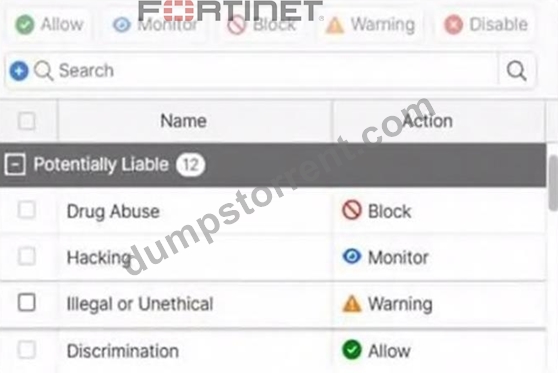
- A. Illegal or Unethical
- B. Hacking
- C. Drug Abuse
- D. Discrimination
Answer: C
Explanation:
The Drug Abuse category is set to Block, which denies access and displays a replacement message to the user.
NEW QUESTION # 28
SD-WAN interacts with many other FortiGate features. Some of them are required to allow SD-WAN to steer the traffic.
Which three configuration elements must you configure before FortiGate can steer traffic according to SD- WAN rules? (Choose three.)
- A. Interfaces
- B. Security profiles
- C. Traffic shaping
- D. Routing
- E. Firewall policies
Answer: A,D,E
Explanation:
According to theSD-WAN 7.6 Core Administratorstudy guide and theFortiOS 7.6 Administration Guide, for the FortiGate SD-WAN engine to successfully steer traffic using SD-WAN rules, three fundamental configuration components must be in place. This is because the SD-WAN rule lookup occurs only after certain initial conditions are met in the packet flow:
* Interfaces (Option C):You must first define the physical or logical interfaces (such as ISP links, LTE, or VPN tunnels) asSD-WAN members. These members are then typically grouped intoSD-WAN Zones. Without designated member interfaces, there is no "pool" of links for the SD-WAN rules to select from.
* Routing (Option D):For a packet to even be considered by the SD-WAN engine, there must be a matching route in theForwarding Information Base (FIB). Usually, this is a static route where the destination is the network you want to reach, and the gateway interface is set to theSD-WAN virtual interface(or a specific SD-WAN zone). If there is no route pointing to SD-WAN, the FortiGate will use other routing table entries (like a standard static route) and bypass the SD-WAN rule-based steering logic entirely.
* Firewall Policies (Option A):In FortiOS, no traffic is allowed to pass through the device unless a Firewall Policypermits it. To steer traffic, you must have a policy where theIncoming Interfaceis the internal network and theOutgoing Interfaceis the SD-WAN zone (or the virtual-wan-link). The SD- WAN rule selection happens during the "Dirty" session state, which requires a policy match to proceed with the session creation.
Why other options are incorrect:
* Security Profiles (Option B):While mandatory forApplication-levelsteering (to identify L7 signatures), basic SD-WAN steering based on IP addresses, ports, or ISDB objects does not require security profiles to be active.
* Traffic Shaping (Option E):This is an optimization feature used to manage bandwidth once steering is already determined; it is not a prerequisite for the steering engine itself to function.
NEW QUESTION # 29
Refer to the exhibit. Which conclusion can you draw from the exhibit?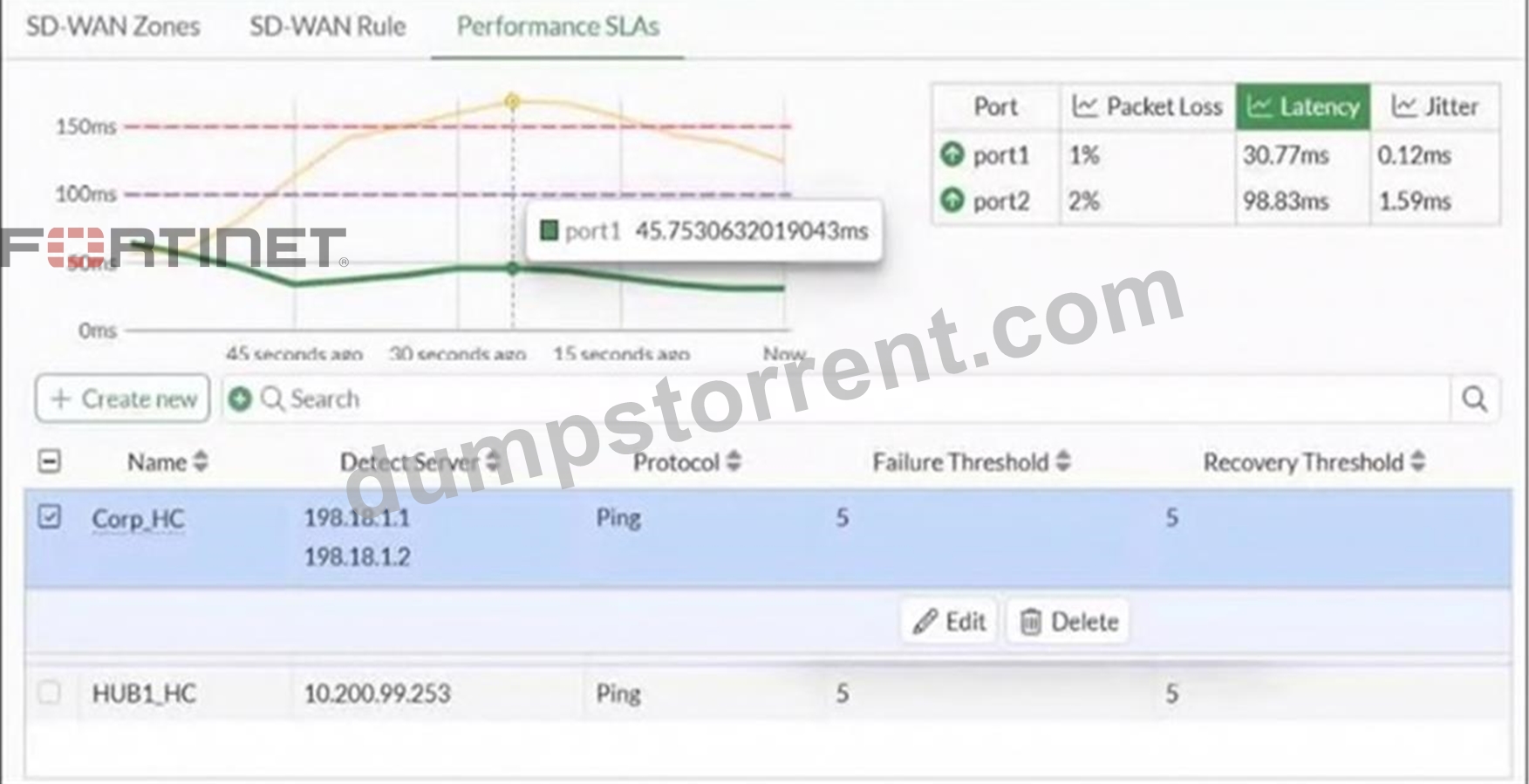
- A. Over the past 60 seconds, the member port2 latency was temporarily above the latency criteria defined for HUB1_HC.
- B. The administrator configured the Corp_HC performance service-level agreement (SLA) with SLA targets for the three criteria: packet loss, latency, and jitter.
- C. The administrator configured the packet loss threshold for Corp_HC and HUB1_HC to 5%.
- D. Over the past 60 seconds, the member port1 was monitored healthy for both latency criteria of the Corp_HC definition.
Answer: D
Explanation:
The graph shows the latency history for the Corp_HC SLA, and port1's latency remained below the defined threshold during the past 60 seconds. This indicates that port1 continuously met the Corp_HC latency SLA and was therefore monitored as healthy.
NEW QUESTION # 30
What is the purpose of the priority/failover connection feature in FortiSASE Geofencing for managing VPN connections?
- A. It forces all remote users to connect only to the nearest security POP regardless of location.
- B. It restricts VPN access to users based on their geolocation without allowing failover options.
- C. It automatically balances VPN traffic across all available security POPs without prioritizing on- premises devices.
- D. It allows administrators to define rules to prioritize on-premises FortiGate connections for users in specific countries, with failover to a security POP if the FortiGate device is unavailable.
Answer: D
Explanation:
Priority/failover in FortiSASE geofencing lets administrators prefer an on-premises FortiGate for users in specified countries and fail over to a FortiSASE security POP only if the on-premises device is unreachable.
NEW QUESTION # 31
The IT team is wondering whether they will need to continue using MDM tools for future FortiClient upgrades.
What options are available for handling future FortiClient upgrades?
- A. Perform onboarding for managed endpoint users with a newer FortiClient version.
- B. A newer FortiClient version will be auto-upgraded on demand.
- C. FortiClient will need to be manually upgraded.
- D. Enable the Endpoint Upgrade feature on the FortiSASE portal.
Answer: D
Explanation:
According to theFortiSASE 7.6 Feature Administration Guideand the latest updates to theNSE 5 SASE curriculum, FortiSASE has introduced native lifecycle management for FortiClient agents to reduce the operational burden on IT teams who previously relied solely on third-party MDM (Mobile Device Management) or GPO (Group Policy Objects) for every update.
TheEndpoint Upgradefeature, found underSystem > Endpoint Upgradein the FortiSASE portal, allows administrators to perform the following:
* Centralized Version Control: Administrators can see which versions are currently deployed and which "Recommended" versions are available from FortiGuard.
* Scheduled Rollouts: You can choose to upgrade all endpoints or specific endpoint groups at a designated time, ensuring that upgrades do not disrupt business operations.
* Status Monitoring: The portal provides a real-time dashboard showing the progress of the upgrade (e.
g.,Downloading,Installing,Reboot Pending, orSuccess).
* Manual vs. Managed: While MDM is still highly recommended for theinitial onboarding(the first time FortiClient is installed and connected to the SASE cloud), all subsequent upgrades can be handled natively by the FortiSASE portal.
Why other options are incorrect:
* Option B: Manual upgrades are inefficient for large-scale deployments (~400 users in this scenario) and are not the intended "feature-rich" solution provided by FortiSASE.
* Option C: "Onboarding" refers to the initial setup. Re-onboarding every time a version changes would be redundant and counterproductive.
* Option D: While the system canmanagethe upgrade, it is not "auto-upgraded on demand" by the client itself without administrative configuration in the portal. The administrator must still define the target version and schedule.
NEW QUESTION # 32
SD-WAN interacts with many other FortiGate features. Some of them are required to allow SD- WAN to steer the traffic.
Which three configuration elements must you configure before FortiGate can steer traffic according to SD-WAN rules? (Choose three.)
- A. Interfaces
- B. Security profiles
- C. Traffic shaping
- D. Routing
- E. Firewall policies
Answer: A,D,E
Explanation:
Routing: For a packet to even be considered by the SD-WAN engine, there must be a matching route in the Forwarding Information Base (FIB). Usually, this is a static route where the destination is the network you want to reach, and the gateway interface is set to the SD-WAN virtual interface (or a specific SD-WAN zone). If there is no route pointing to SD-WAN, the FortiGate will use other routing table entries (like a standard static route) and bypass the SD- WAN rule-based steering logic entirely.
Interfaces: You must first define the physical or logical interfaces (such as ISP links, LTE, or VPN tunnels) as SD-WAN members. These members are then typically grouped into SD-WAN Zones.
Without designated member interfaces, there is no "pool" of links for the SD-WAN rules to select from.
Firewall Policies: In FortiOS, no traffic is allowed to pass through the device unless a Firewall Policy permits it. To steer traffic, you must have a policy where the Incoming Interface is the internal network and the Outgoing Interface is the SD-WAN zone (or the virtual-wan-link). The SD- WAN rule selection happens during the "Dirty" session state, which requires a policy match to proceed with the session creation.
NEW QUESTION # 33 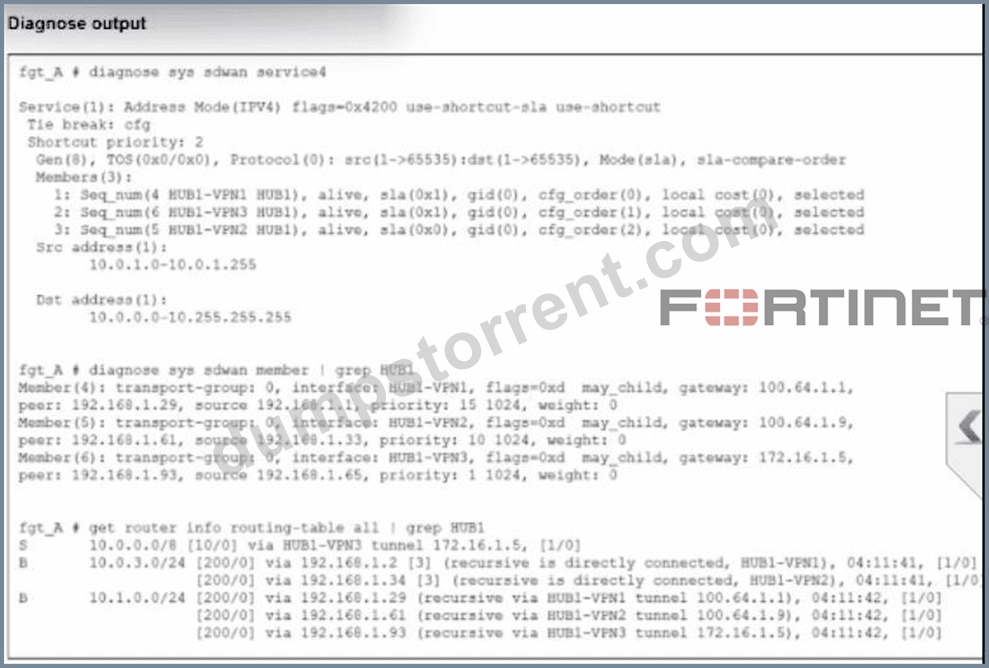
An administrator is troubleshooting SD-WAN on FortiGate. A device behind branch1_fgt generates traffic to the 10.0.0.0/8 network. The administrator expects the traffic to match SD-WAN rule ID 1 and be routed over HUB1-VPN1. However, the traffic is routed over HUB1-VPN3.
Based on the output shown in the exhibit, which two reasons, individually or together, could explain the observed behavior? (Choose two.)
- A. HUB1-VPN3 has a lower route priority value (higher priority) than HUB1-VPN1.
- B. HUB1-VPN3 has a higher member configuration priority than HUB1-VPN1.
- C. The traffic matches a regular policy route configured with HUB1-VPN3 as the outgoing device.
- D. HUB1-VPN1 does not have a valid route to the destination.
Answer: A,D
Explanation:
According to theSD-WAN 7.6 Core Administratorcurriculum and the diagnostic outputs shown in the exhibit, the reason traffic is steered toHUB1-VPN3instead of the expectedHUB1-VPN1(defined in SD-WAN rule ID 1) can be explained by two core routing principles in FortiOS:
* Valid Route Requirement (Option A): In thediagnose sys sdwan service 4output (which corresponds to Rule ID 1), it shows the rule has membersHUB1-VPN1,HUB1-VPN2, andHUB1-VPN3. A key principle of SD-WAN steering is that for a member to be "selectable" by a rule, itmust have a valid route to the destinationin the routing table (RIB/FIB). If the routing table output (the third section of the exhibit) shows a route to 10.0.0.0/8 viaHUB1-VPN3butnotthroughHUB1-VPN1, the SD-WAN engine will skip HUB1-VPN1 entirely because it is considered a "non-reachable" path for that specific destination.
* Policy Route Precedence (Option D): In the FortiOS route lookup hierarchy,Regular Policy Routes (PBR)are evaluatedbeforeSD-WAN rules. If an administrator has configured a traditional Policy Route (found underNetwork > Policy Routes) that matches traffic destined for 10.0.0.0/8 and specifiesHUB1- VPN3as the outgoing interface, the FortiGate will forward the packet based on that policy route and will never evaluate the SD-WAN rulesfor that session. This "bypass" occurs regardless of whether the SD- WAN rule would have chosen a "better" link.
Why other options are incorrect:
* Option B: While member configuration priority (cfg_order) is a tie-breaker in some strategies, the SD- WAN rule logic is only applied if the routing table allows it or if a higher-priority policy route doesn't intercept the traffic first.
* Option C: Lower route priority (which means higher preference in the RIB) affects theImplicit Rule (standard routing). However, SD-WAN rules are designed tooverrideRIB priority for matching traffic.
If HUB1-VPN1 was a valid candidate and no Policy Route existed, the SD-WAN rule would typically ignore RIB priority to enforce its own steering strategy.
NEW QUESTION # 34
Which statement about security posture tags in FortiSASE is correct?
- A. Multiple tags can be assigned to an endpoint, but only one is used for evaluation.
- B. Only one tag can be assigned to an endpoint.
- C. Tags are static and do not change with endpoint status.
- D. Multiple tags can be assigned to an endpoint and used for evaluation.
Answer: D
Explanation:
Security posture tags in FortiSASE dynamically assess endpoint compliance based on rules like OS version, antivirus status, and FortiClient connectivity. Endpoints receive multiple tags simultaneously (e.g., for Windows 11, active AV, and SASE connection), which firewalls then evaluate in policies for ZTNA access control.
NEW QUESTION # 35
Which FortiSASE feature monitors SaaS application performance and connectivity to points of presence (POPs)?
- A. Operations widgets
- B. Digital experience monitoring
- C. FortiView dashboards
- D. Event logs
Answer: B
Explanation:
According to theFortiSASE 7.6 Administration GuideandDigital Experience Monitoring (DEM) documentation, the feature specifically designed to monitor SaaS application performance and connectivity to PoPs isDigital Experience Monitoring (DEM).
* SaaS and Path Visibility: DEM assists administrators in troubleshooting remote user connectivity issues by providing enhanced health check visibility forSaaS applications, endpoint devices, and the network path. It provides real-time insights into application performance and latency issues.
* PoP Connectivity: It monitors the digital journey from the end-user device through theSecurity Points of Presence (POPs)to the final application, identifying hops where degraded service (packet loss, delay, or jitter) is detected.
* Proactive Management: By establishing thresholds and simulating user activities throughSynthetic Transaction Monitoring (STM), DEM allows IT teams to identify performance problems before they impact the business.
Why other options are incorrect:
* Option A: Operations widgets provide general status overviews but do not offer the granular per-hop path analysis or specific SaaS transaction monitoring found in DEM.
* Option B: FortiView dashboards provide traffic visibility and session data but are not dedicated performance monitoring tools for end-to-end digital experience.
* Option C: Event logs record system occurrences and security events but do not provide real-time performance metrics or health check probes for SaaS applications.
NEW QUESTION # 36
Which statement about FortiSASE CASB capabilities is true?
- A. FortiSASE provides only API-based CASB.
- B. FortiSASE provides CASB capabilities only through Security Fabric integration.
- C. FortiSASE provides only inline CASB.
- D. FortiSASE provides both API-based CASB and inline CASB.
Answer: C
Explanation:
FortiSASE includes inline CASB capabilities, enforcing cloud application controls directly on user traffic. API-based CASB is not included in FortiSASE.
NEW QUESTION # 37
......
Changing the Concept of NSE5_SSE_AD-7.6 Exam Preparation 2026: https://troytec.dumpstorrent.com/NSE5_SSE_AD-7.6-exam-prep.html