

Get 100% Authentic Microsoft AZ-104 Dumps with Correct Answers
New Training Course AZ-104 Tutorial Preparation Guide
What is Microsoft AZ-104 Exam
The Microsoft az-104 certification exam, also known as the Microsoft Certified Solutions Associate (MCSA): Microsoft Azure Solutions Architect Certification is a test provided by Microsoft for IT professionals. The test measures how well you understand Azure technologies and includes both technical and behavioral questions. Implementing some of the more basic Microsoft Azure technology solutions is another focus of this exam. You can take the test on any computer, either at home or on your mobile device. However, it is best to take this test in a quiet place with no distractions. Employers are always looking for certified professionals. Credential holders are able to expand their knowledge, expand their skillset, and increase their marketability. Solid test takers are able to move into leadership roles with larger organizations.
Fundamental knowledge of cloud computing and its many functions will give you an advantage on the exam. Aspects of Azure are covered in-depth, but you should also be familiar with other cloud computing technologies as well. Affiliate marketing, SEO, and websites are common areas of focus. Microsoft AZ-104 exam dumps also include each of the objectives covered, which you may find useful. Servicecreate and Serviceupdate and project and security and identity and storage and messaging and rendering all require knowledge of these technologies. Country and regional settings for all of these Azure regions are also covered. Units of measurement are also an important piece of this exam.
NEW QUESTION # 31
You have an Azure subscription that contains the following resources:
* a virtual network named VNet1
* a replication policy named ReplPolicy1
* a Recovery Services vault named Vault1
* an Azure Storage account named Storage1
You have an Amazon Web Services (AWS) EC2 virtual machine named VM1 that runs Windows Server
You need to migrate VM1 to VNet1 by using Azure Site Recovery.
Which three actions should you perform in sequence? To answer, move the appropriate actions from the list of actions to the answer area and arrange them in the correct order.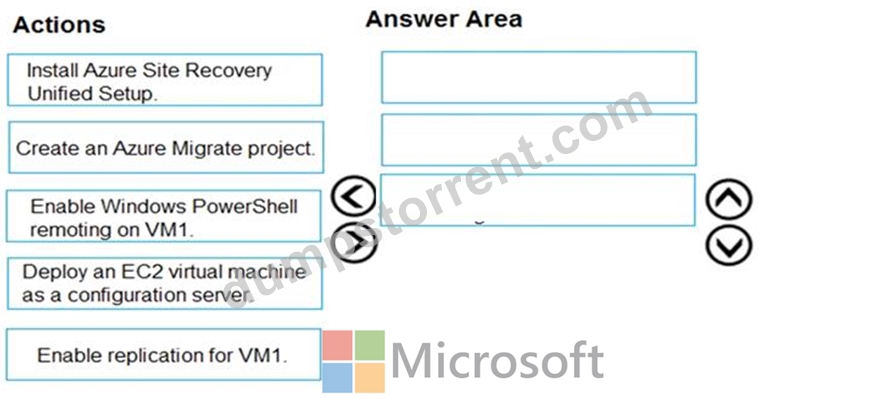
Answer:
Explanation: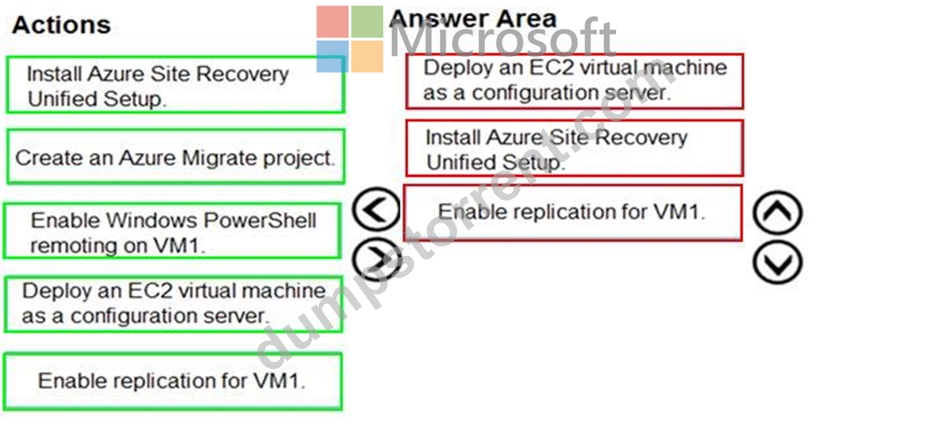
Explanation:
Step 1: Deploy an EC2 virtual machine as a configuration server
Prepare source include:
Use an EC2 instance that's running Windows Server 2012 R2 to create a configuration server and register it with your recovery vault.
Configure the proxy on the EC2 instance VM you're using as the configuration server so that it can access the service URLs.
Step 2: Install Azure Site Recovery Unified Setup.
Download Microsoft Azure Site Recovery Unified Setup. You can download it to your local machine and then copy it to the VM you're using as the configuration server.
Step 3: Enable replication for VM1.
Enable replication for each VM that you want to migrate. When replication is enabled, Site Recovery automatically installs the Mobility service.
References:
https://docs.microsoft.com/en-us/azure/site-recovery/migrate-tutorial-aws-azure
NEW QUESTION # 32
You have a pay-as-you-go Azure subscription that contains the virtual machines shown in the following table.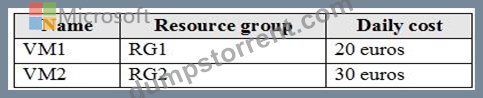
You create the budget shown in the following exhibit.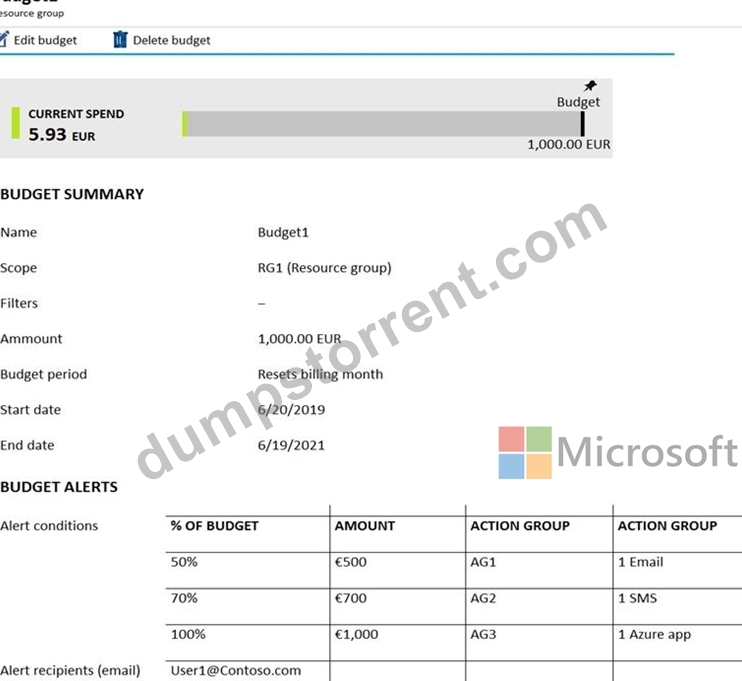
The AG1 action group contains a user named [email protected] only.
Use the drop-down menus to select the answer choice that completes each statement based on the information presented in the graphic.
NOTE: Each correct selection is worth one point.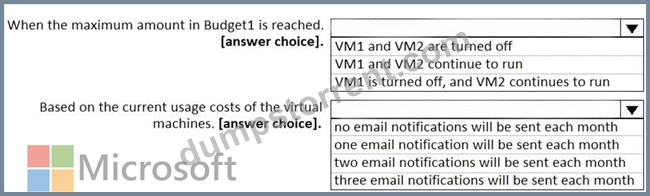
Answer:
Explanation: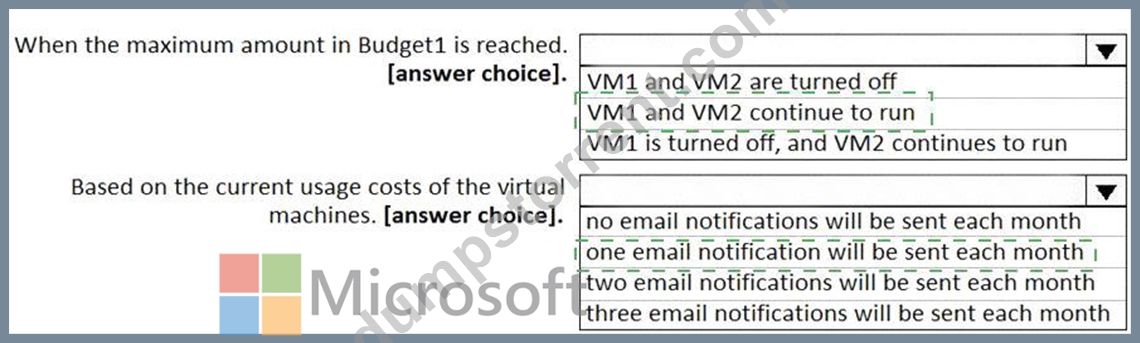
Explanation
Box 1: VM1 and VM2 continues to run
When the budget thresholds you've created are exceeded, only notifications are triggered. None of your resources are affected and your consumption isn't stopped. You can use budgets to compare and track spending as you analyze costs.
Box 2: one email notification will be sent each month
Budget alerts for Resource Group RG1, which include VM1, but not VM2.VM1 consumes 20 Euro/day. The
50% ,500 Euro limit, will be reached in 25 days, and an email will be sent.
The 70% and 100% alert conditions will not be reached within a month, and they don't trigger email actions anyway.
References:
https://docs.microsoft.com/en-gb/azure/cost-management-billing/costs/tutorial-acm-create-budgets
https://docs.microsoft.com/en-us/azure/cost-management-billing/costs/cost-mgt-alerts-monitor-usage-spending
NEW QUESTION # 33
You have an Azure subscription that is used by four departments in your company. The subscription contains
10 resource groups. Each department uses resources in several resource groups.
You need to send a report to the finance department. The report must detail the costs for each department.
Which three actions should you perform in sequence? To answer, move the appropriate actions from the list of actions to the answer area and arrange them in the correct order.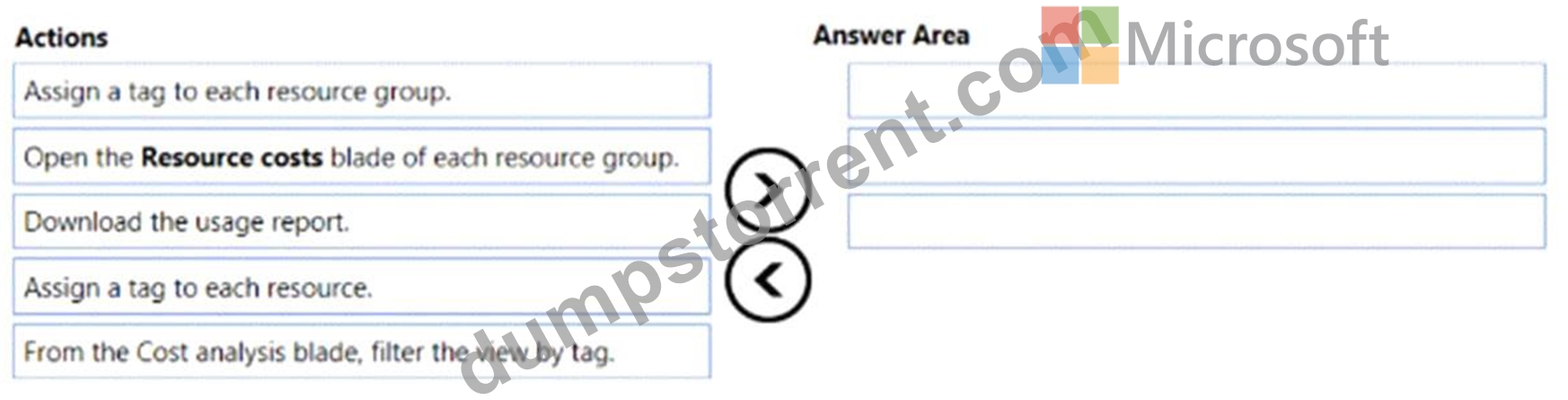
Answer:
Explanation: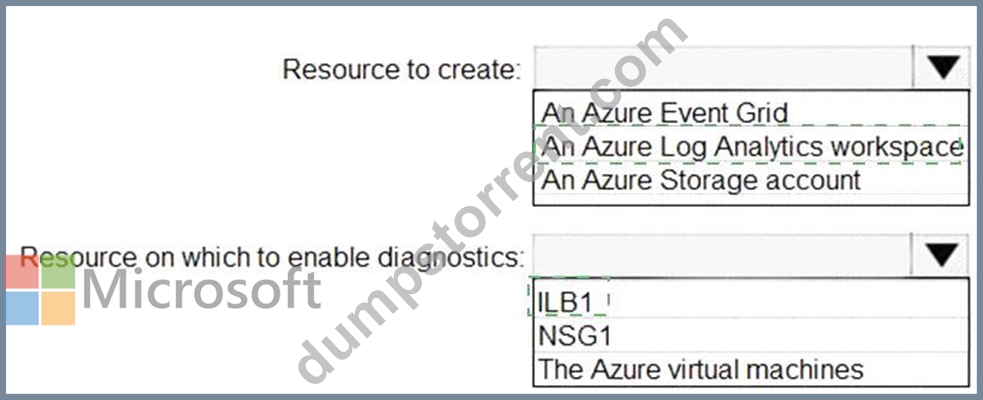
Explanation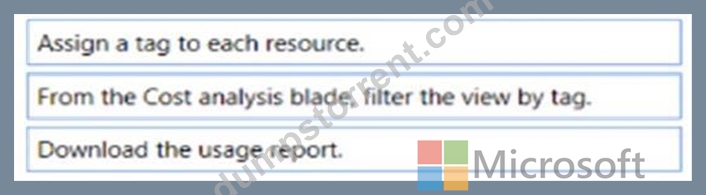
Box 1: Assign a tag to each resource.
You apply tags to your Azure resources giving metadata to logically organize them into a taxonomy. After you apply tags, you can retrieve all the resources in your subscription with that tag name and value. Each resource or resource group can have a maximum of 15 tag name/value pairs. Tags applied to the resource group are not inherited by the resources in that resource group.
Box 2: From the Cost analysis blade, filter the view by tag
After you get your services running, regularly check how much they're costing you. You can see the current spend and burn rate in Azure portal.
* Visit the Subscriptions blade in Azure portal and select a subscription.
* You should see the cost breakdown and burn rate in the popup blade.
* Click Cost analysis in the list to the left to see the cost breakdown by resource. Wait 24 hours after you add a service for the data to populate.
* You can filter by different properties like tags, resource group, and timespan. Click Apply to confirm the filters and Download if you want to export the view to a Comma-Separated Values (.csv) file.
Box 3: Download the usage report
References:
https://docs.microsoft.com/en-us/azure/azure-resource-manager/resource-group-using-tags
https://docs.microsoft.com/en-us/azure/billing/billing-getting-started
NEW QUESTION # 34
You have an Azure subscription named Subscription1.
Subscription1 contains the virtual machines in the following table.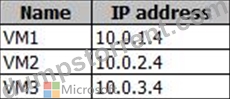
Subscription1 contains a virtual network named VNet1 that has the subnets in the following table.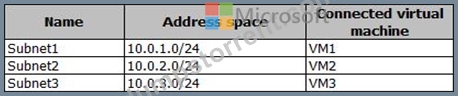
VM3 has a network adapter named NIC3. IP forwarding is enabled on NIC3. Routing is enabled on VM3.
You create a route table named RT1. RT1 is associated to Subnet1 and Subnet2 and contains the routes in the following table.
You apply RT1 to Subnet1.
For each of the following statements, select Yes if the statement is true. Otherwise, select No.
NOTE: Each correct selection is worth one point.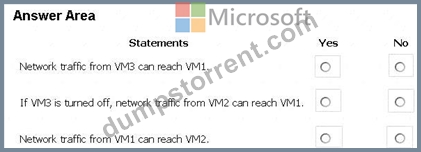
Answer:
Explanation: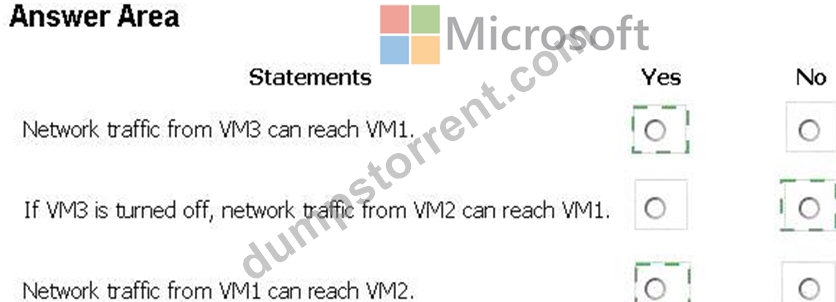
Explanation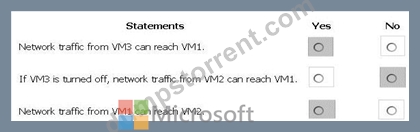
Box 1: Yes
Traffic from VM1 and VM2 can reach VM3 thanks to the routing table, and as IP forwarding is enabled on VM3, traffic from VM3 can reach VM1.
Box 2: No
VM3, which has IP forwarding, must be turned on, in order for traffic from VM2 to reach VM1.
Box 3: Yes
The traffic from VM1 will reach VM3, which thanks to IP forwarding, will send the traffic to VM2.
Reference:
https://docs.microsoft.com/en-us/azure/virtual-network/virtual-networks-udr-overview
NEW QUESTION # 35
You have an Azure subscription that contains the resources shown in the following table:
You assign a policy to RG6 as shown in the following table: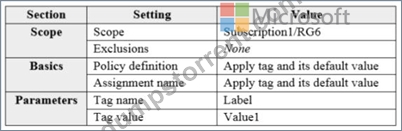
To RG6, you apply the tag: RGroup: RG6.
You deploy a virtual network named VNET2 to RG6.
Which tags apply to VNET1 and VNET2? To answer, select the appropriate options in the answer area.
NOTE: Each correct selection is worth one point.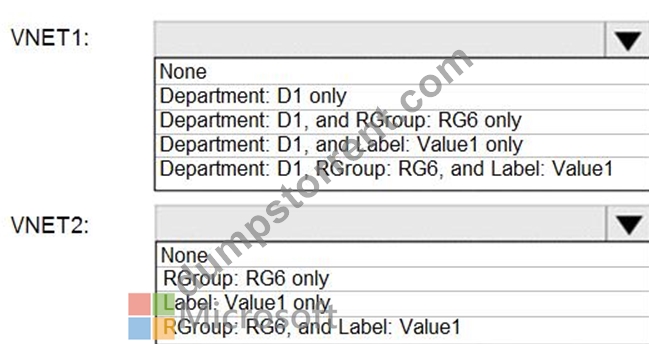
Answer:
Explanation: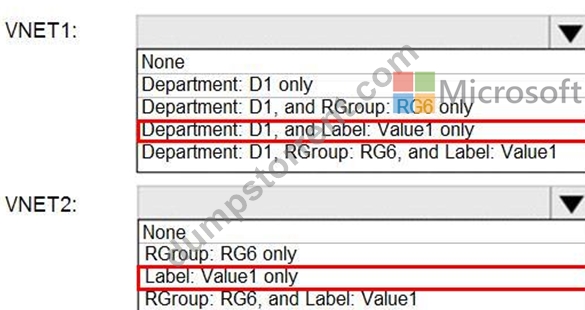
Explanation:
VNET1: Department: D1, and Label:Value1 only.
Tags applied to the resource group or subscription are not inherited by the resources.
Note: Azure Policy allows you to use either built-in or custom-defined policy definitions and assign them to either a specific resource group or across a whole Azure subscription.
VNET2: Label:Value1 only.
Incorrect Answers:
RGROUP: RG6
Tags applied to the resource group or subscription are not inherited by the resources.
Reference:
https://docs.microsoft.com/en-us/azure/azure-resource-manager/management/tag-policies
NEW QUESTION # 36
You have an Azure subscription named Subscription1 that contains the resources shown in the following table.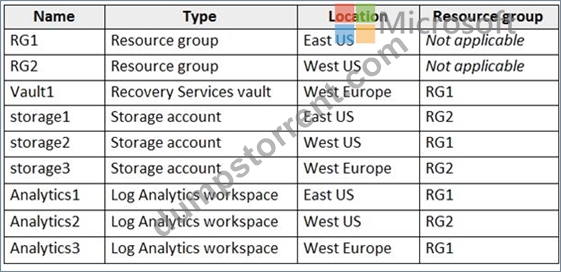
You plan to configure Azure Backup reports for Vault1.
You are configuring the Diagnostics settings for the AzureBackupReports log.
Which storage accounts and which Log Analytics workspaces can you use for the Azure Backup reports of Vault1? To answer, select the appropriate options in the answer area.
NOTE: Each correct selection is worth one point.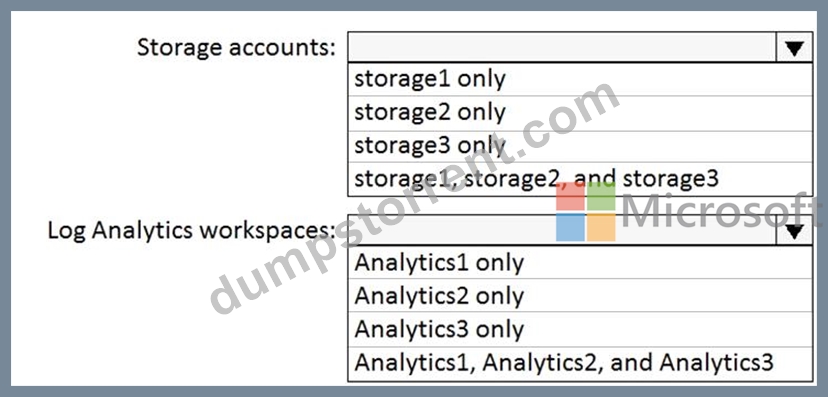
Answer:
Explanation: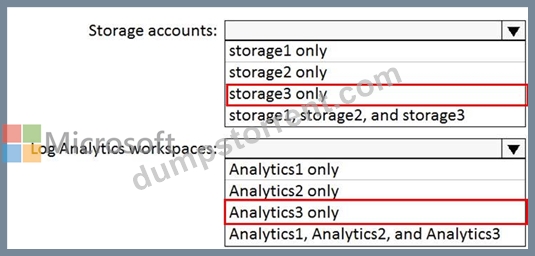
References:
https://docs.microsoft.com/en-us/azure/backup/backup-azure-configure-reports
NEW QUESTION # 37
You have an Azure subscription.
You create the Azure Storage account shown in the following exhibit.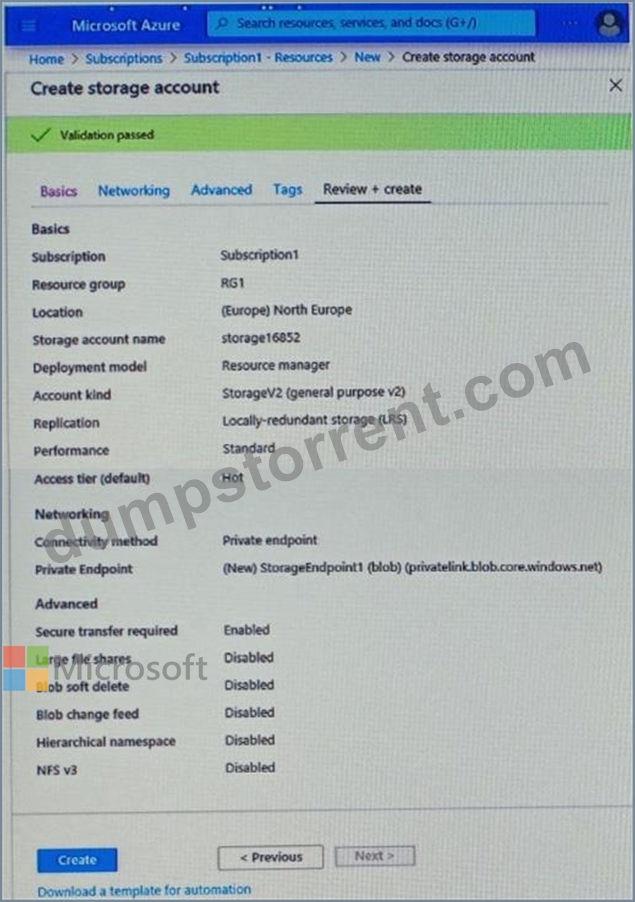
Use the drop-down menus to select the answer choice that completes each statement based on the information presented in the graphic.
NOTE: Each correct selection is worth one point.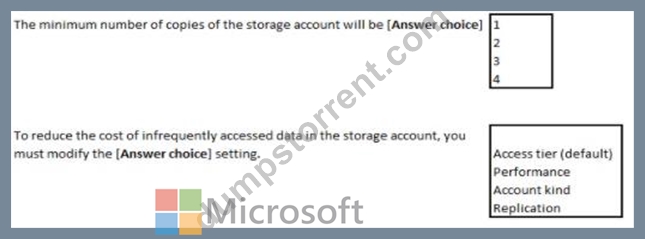
Answer:
Explanation: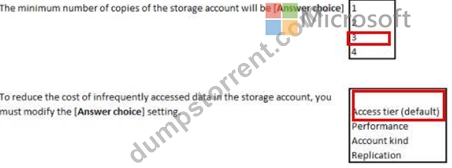
Reference:
https://azure.microsoft.com/en-in/pricing/calculator/?service=storage
NEW QUESTION # 38
You have an Azure Subscription named Subcription1.has
Subcription1 contains the virtual machines in the following table.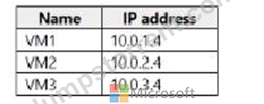
Subcription1 contains the virtual machines in the following table.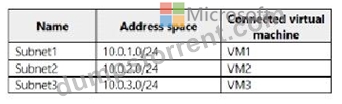
VM3 has multiple network, including a network adapter named NIC3, IP forwarding is enabled on NIC3. Routing is enabled on VM3.
You create a route table named RT1 that contains the routes in the following table.
You apply RT1 to subnet1 and Sybnet2.
For each of the following statements, select Yes if the statements is true. Otherwise, select No.
NOTE: Each correct selection is worth one point.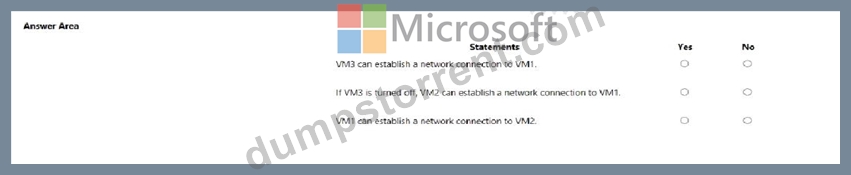
Answer:
Explanation: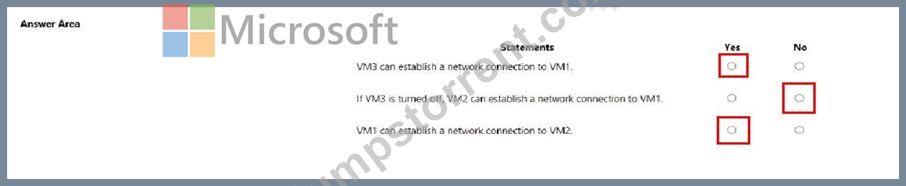
Explanation:
IP forwarding enables the virtual machine a network interface is attached to:
Receive network traffic not destined for one of the IP addresses assigned to any of the IP configurations assigned to the network interface.
Send network traffic with a different source IP address than the one assigned to one of a network interface's IP configurations.
The setting must be enabled for every network interface that is attached to the virtual machine that receives traffic that the virtual machine needs to forward. A virtual machine can forward traffic whether it has multiple network interfaces or a single network interface attached to it.
Box 1: Yes
The routing table allows connections from VM3 to VM1 and VM2. And as IP forwarding is enabled on VM3, VM3 can connect to VM1.
Box 2: No
VM3, which has IP forwarding, must be turned on, in order for VM2 to connect to VM1.
Box 3: Yes
The routing table allows connections from VM1 and VM2 to VM3. IP forwarding on VM3 allows VM1 to connect to VM2 via VM3.
References:
https://docs.microsoft.com/en-us/azure/virtual-network/virtual-networks-udr-overview
https://www.quora.com/What-is-IP-forwarding
NEW QUESTION # 39
You need to deploy two Azure web apps named WebApp1 and WebApp2. The web apps have the following requirements:
WebApp1 must be able to use staging slots
WebApp2 must be able to access the resources located on an Azure virtual network What is the least costly plan that you can use to deploy each web app? To answer, select the appropriate options in the answer area.
NOTE: Each correct selection is worth one point.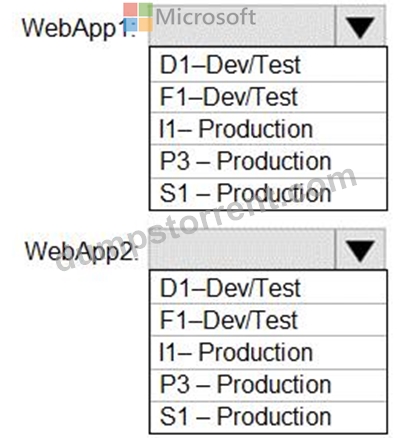
Answer:
Explanation: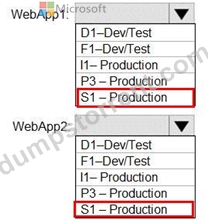
References:
https://azure.microsoft.com/en-au/pricing/details/app-service/windows/
https://azure.microsoft.com/en-gb/pricing/details/app-service/plans/
NEW QUESTION # 40
You have an Azure subscription named Subscription1 that contains an Azure virtual network named VM1.
VM1 is in a resource group named RG1.
VM1 runs services that will be used to deploy resources to RG1.
You need to ensure that a service running on VM1 can manage the resources in RG1 by using the identity of VM1.
What should you do first?
- A. From the Azure portal, modify the Policies settings of RG1.
- B. From the Azure portal, modify the value of the Managed Service Identity option for VM1.
- C. From the Azure portal modify the Access control (1AM) settings of VM1.
- D. From the Azure portal, modify the Access control (IAM) settings of RG1.
Answer: B
Explanation:
A managed identity from Azure Active Directory allows your app to easily access other AAD-protected resources such as Azure Key Vault. The identity is managed by the Azure platform and does not require you to provision or rotate any secrets.
User assigned managed identities can be used on Virtual Machines and Virtual Machine Scale Sets.
References:
https://docs.microsoft.com/en-us/azure/app-service/app-service-managed-service-identity
NEW QUESTION # 41
You have an Azure subscription named Subscription1.
In Subscription1, you create an Azure web app named WebApp1. WebApp1 will access an external service that requires certificate authentication.
You plan to require the use of HTTPS to access WebApp1.
You need to upload certificates to WebApp1.
In which formats should you upload the certificate? To answer, select the appropriate options in the answer area.
NOTE: Each correct selection is worth one point.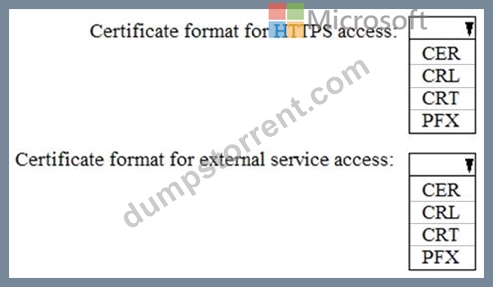
Answer:
Explanation: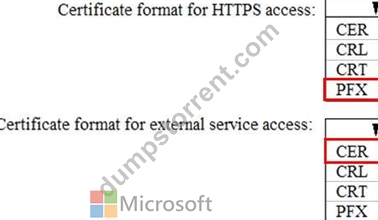
Explanation:
A PFX file contains the public key file (SSL Certificate) and its unique private key file. This is required for HTTPS access. The web app will distribute the public key (in a CER file) to clients that connect to the web app.
The CER file is an SSL Certificate which has the public key of the external service. The external service will have the private key associated with the public key contained in the CER file.
NEW QUESTION # 42
Your company has offices in New York and Los Angeles.
You have an Azure subscription that contains an Azure virtual network named VNet1. Each office has a site-to-site VPN connection to VNet1.
Each network uses the address spaces shown in the following table.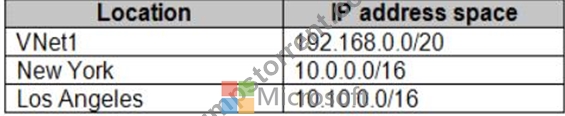
You need to ensure that all Internet-bound traffic from VNet1 is routed through the New York office.
What should you do? To answer, select the appropriate options in the answer area.
NOTE: Each correct selection is worth one point.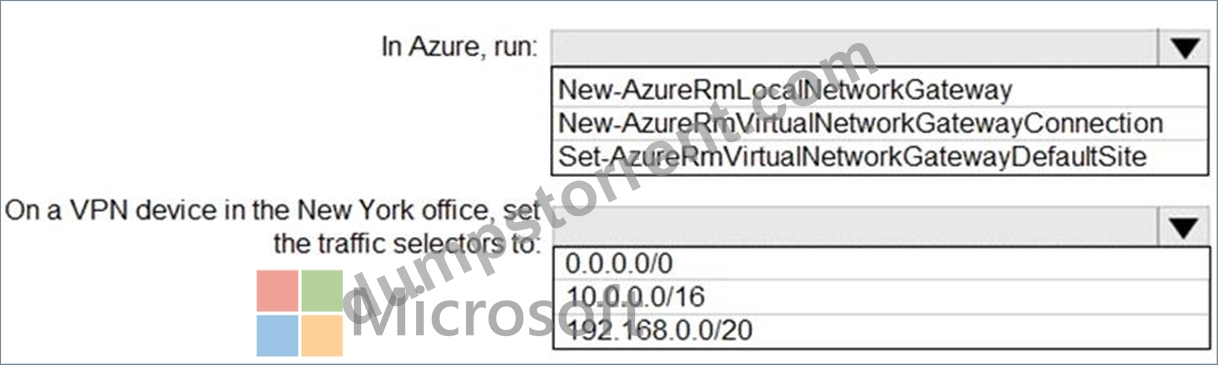
Answer:
Explanation: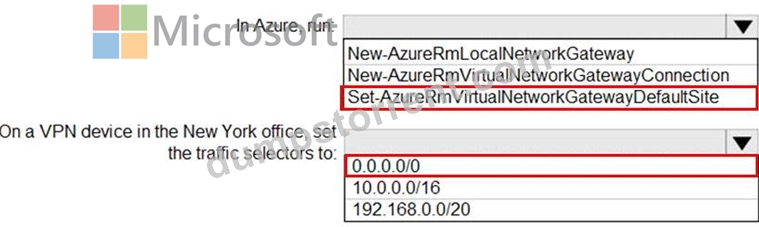
Reference:
https://docs.microsoft.com/en-us/powershell/module/azurerm.network/set-azurermvirtualnetworkgatewaydefaultsite?view=azurermps-6.13.0
https://docs.microsoft.com/en-us/azure/vpn-gateway/vpn-gateway-forced-tunneling-rm
NEW QUESTION # 43
You have an Azure subscription that contains an Azure Storage account named storage1 and the users shown in the following table.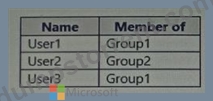
You plan to monitor storage1 and to configure email notifications for the signals shown in the following table.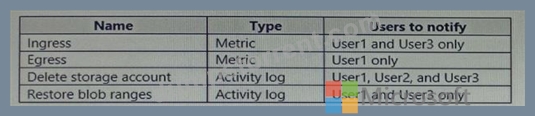
You need to identify the minimum number of alert rules and action groups required for the planned monitoring.
How many alert rules and action groups should you identify? To answer, select the appropriate options in the answer area.
NOTE: Each correct selection is worth one point.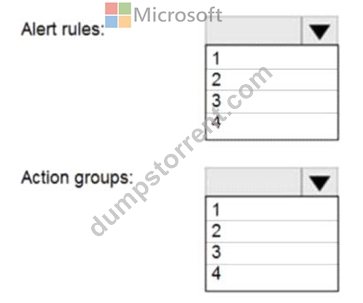
Answer:
Explanation: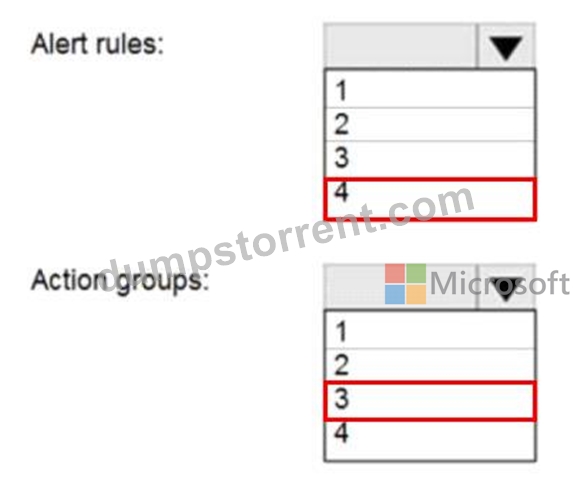
Reference:
https://docs.microsoft.com/en-us/azure/azure-monitor/platform/action-groups
NEW QUESTION # 44
You have the App Service plans shown in the following table.
You plan to create the Azure web apps shown in the following table.
You need to identify which App Service plans can be used for the web apps.
What should you identify? To answer, select the appropriate options in the answer area.
NOTE: Each correct selection is worth one point.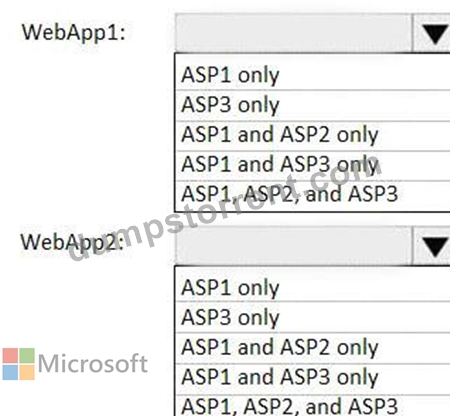
Answer:
Explanation: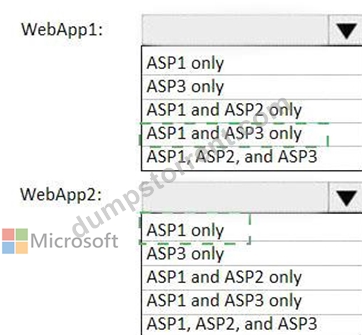
Explanation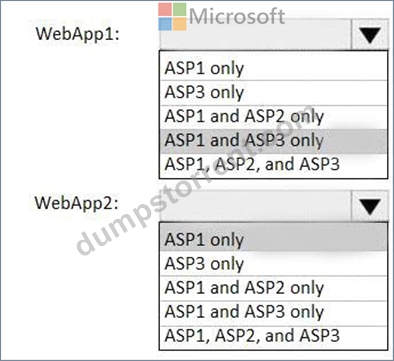
Box 1: ASP1 ASP3
Asp1, ASP3: ASP.NET Core apps can be hosted both on Windows or Linux.
Not ASP2: The region in which your app runs is the region of the App Service plan it's in.
Box 2: ASP1
ASP.NET apps can be hosted on Windows only.
Reference:
https://docs.microsoft.com/en-us/azure/app-service/quickstart-dotnetcore?pivots=platform-linux
https://docs.microsoft.com/en-us/azure/app-service/app-service-plan-manage#
NEW QUESTION # 45
You have an Azure subscription that contains the resources shown in the following table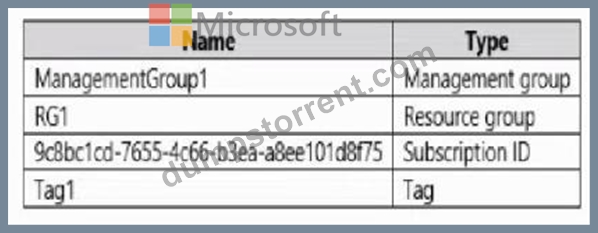
In Azure Cloud Shell, you need to create a virtual machine by using an Azure Resource Manager (ARM) template.
How should you complete the command? To answer, select the appropriate options in the answer area, NOTE: Each correct selection is worth one point.
Answer:
Explanation:
Reference:
https://docs.microsoft.com/en-us/powershell/module/az.resources/new-azresourcegroupdeployment?view=azps-6.6.0
NEW QUESTION # 46
......
Dumps of AZ-104 Cover all the requirements of the Real Exam: https://troytec.dumpstorrent.com/AZ-104-exam-prep.html