

Get Ready with Databricks-Certified-Data-Engineer-Associate Exam Dumps (2025)
Realistic Databricks-Certified-Data-Engineer-Associate Dumps are Available for Instant Access
To prepare for the Databricks-Certified-Data-Engineer-Associate exam, individuals can take advantage of a range of resources. These resources include online courses, practice exams, and study guides. It is also recommended that individuals gain practical experience working with Databricks before taking the exam.
NEW QUESTION # 25
A data engineer is maintaining a data pipeline. Upon data ingestion, the data engineer notices that the source data is starting to have a lower level of quality. The data engineer would like to automate the process of monitoring the quality level.
Which of the following tools can the data engineer use to solve this problem?
- A. Delta Lake
- B. Auto Loader
- C. Data Explorer
- D. Unity Catalog
- E. Delta Live Tables
Answer: E
NEW QUESTION # 26
Which of the following describes a scenario in which a data team will want to utilize cluster pools?
- A. An automated report needs to be tested to identify errors.
- B. An automated report needs to be version-controlled across multiple collaborators.
- C. An automated report needs to be runnable by all stakeholders.
- D. An automated report needs to be made reproducible.
- E. An automated report needs to be refreshed as quickly as possible.
Answer: C
NEW QUESTION # 27
A dataset has been defined using Delta Live Tables and includes an expectations clause:
CONSTRAINT valid_timestamp EXPECT (timestamp > '2020-01-01') ON VIOLATION FAIL UPDATE What is the expected behavior when a batch of data containing data that violates these constraints is processed?
- A. Records that violate the expectation cause the job to fail.
- B. Records that violate the expectation are dropped from the target dataset and loaded into a quarantine table.
- C. Records that violate the expectation are added to the target dataset and recorded as invalid in the event log.
- D. Records that violate the expectation are dropped from the target dataset and recorded as invalid in the event log.
- E. Records that violate the expectation are added to the target dataset and flagged as invalid in a field added to the target dataset.
Answer: A
Explanation:
The expected behavior when a batch of data containing data that violates the expectation is processed is that the job will fail. This is because the expectation clause has the ON VIOLATION FAIL UPDATE option, which means that if any record in the batch does not meet the expectation, the entire batch will be rejected and the job will fail. This option is useful for enforcing strict data quality rules and preventing invalid data from entering the target dataset.
Option A is not correct, as the ON VIOLATION FAIL UPDATE option does not drop the records that violate the expectation, but fails the entire batch. To drop the records that violate the expectation and record them as invalid in the event log, the ON VIOLATION DROP RECORD option should be used.
Option C is not correct, as the ON VIOLATION FAIL UPDATE option does not drop the records that violate the expectation, but fails the entire batch. To drop the records that violate the expectation and load them into a quarantine table, the ON VIOLATION QUARANTINE RECORD option should be used.
Option D is not correct, as the ON VIOLATION FAIL UPDATE option does not add the records that violate the expectation, but fails the entire batch. To add the records that violate the expectation and record them as invalid in the event log, the ON VIOLATION LOG RECORD option should be used.
Option E is not correct, as the ON VIOLATION FAIL UPDATE option does not add the records that violate the expectation, but fails the entire batch. To add the records that violate the expectation and flag them as invalid in a field added to the target dataset, the ON VIOLATION FLAG RECORD option should be used.
References:
* Delta Live Tables Expectations
* [Databricks Data Engineer Professional Exam Guide]
NEW QUESTION # 28
Which of the following describes when to use the CREATE STREAMING LIVE TABLE (formerly CREATE INCREMENTAL LIVE TABLE) syntax over the CREATE LIVE TABLE syntax when creating Delta Live Tables (DLT) tables using SQL?
- A. CREATE STREAMING LIVE TABLE should be used when the previous step in the DLT pipeline is static.
- B. CREATE STREAMING LIVE TABLE should be used when the subsequent step in the DLT pipeline is static.
- C. CREATE STREAMING LIVE TABLE should be used when data needs to be processed incrementally.
- D. CREATE STREAMING LIVE TABLE should be used when data needs to be processed through complicated aggregations.
- E. CREATE STREAMING LIVE TABLE is redundant for DLT and it does not need to be used.
Answer: C
Explanation:
A streaming live table or view processes data that has been added only since the last pipeline update.
Streaming tables and views are stateful; if the defining query changes, new data will be processed based on the new query and existing data is not recomputed. This is useful when data needs to be processed incrementally, such as when ingesting streaming data sources or performing incremental loads from batch data sources. A live table or view, on the other hand, may be entirely computed when possible to optimize computation resources and time. This is suitable when data needs to be processed in full, such as when performing complex transformations or aggregations that require scanning all the data. References: Difference between LIVE TABLE and STREAMING LIVE TABLE, CREATE STREAMING TABLE, Load data using streaming tables in Databricks SQL.
NEW QUESTION # 29
A new data engineering team team. has been assigned to an ELT project. The new data engineering team will need full privileges on the database customers to fully manage the project.
Which of the following commands can be used to grant full permissions on the database to the new data engineering team?
- A. GRANT ALL PRIVILEGES ON DATABASE customers TO team;
- B. GRANT USAGE ON DATABASE customers TO team;
- C. GRANT ALL PRIVILEGES ON DATABASE team TO customers;
- D. GRANT SELECT PRIVILEGES ON DATABASE customers TO teams;
- E. GRANT SELECT CREATE MODIFY USAGE PRIVILEGES ON DATABASE customers TO team;
Answer: A
NEW QUESTION # 30
A data engineer needs to determine whether to use the built-in Databricks Notebooks versioning or version their project using Databricks Repos.
Which of the following is an advantage of using Databricks Repos over the Databricks Notebooks versioning?
- A. Databricks Repos is wholly housed within the Databricks Lakehouse Platform
- B. Databricks Repos provides the ability to comment on specific changes
- C. Databricks Repos supports the use of multiple branches
- D. Databricks Repos automatically saves development progress
- E. Databricks Repos allows users to revert to previous versions of a notebook
Answer: C
Explanation:
Databricks Repos is a visual Git client and API in Databricks that supports common Git operations such as cloning, committing, pushing, pulling, and branch management. Databricks Notebooks versioning is a legacy feature that allows users to link notebooks to GitHub repositories and perform basic Git operations. However, Databricks Notebooks versioning does not support the use of multiple branches for development work, which is an advantage of using Databricks Repos. With Databricks Repos, users can create and manage branches for different features, experiments, or bug fixes, and merge, rebase, or resolve conflicts between them. Databricks recommends using a separate branch for each notebook and following data science and engineering code development best practices using Git for version control, collaboration, and CI/CD. Reference: Git integration with Databricks Repos - Azure Databricks | Microsoft Learn, Git version control for notebooks (legacy) | Databricks on AWS, Databricks Repos Is Now Generally Available - New 'Files' Feature in ..., Databricks Repos - What it is and how we can use it | Adatis.
NEW QUESTION # 31
An engineering manager wants to monitor the performance of a recent project using a Databricks SQL query.
For the first week following the project's release, the manager wants the query results to be updated every minute. However, the manager is concerned that the compute resources used for the query will be left running and cost the organization a lot of money beyond the first week of the project's release.
Which of the following approaches can the engineering team use to ensure the query does not cost the organization any money beyond the first week of the project's release?
- A. They can set the query's refresh schedule to end on a certain date in the query scheduler.
- B. They can set a limit to the number of DBUs that are consumed by the SQL Endpoint.
- C. They can set the query's refresh schedule to end after a certain number of refreshes.
- D. They can set a limit to the number of individuals that are able to manage the query's refresh schedule.
- E. They cannot ensure the query does not cost the organization money beyond the first week of the project's release.
Answer: A
Explanation:
Explanation
If a dashboard is configured for automatic updates, it has a Scheduled button at the top, rather than a Schedule button. To stop automatically updating the dashboard and remove its subscriptions:
Click Scheduled.
In the Refresh every drop-down, select Never.
Click Save. The Scheduled button label changes to Schedule.
Source:https://learn.microsoft.com/en-us/azure/databricks/sql/user/dashboards/
NEW QUESTION # 32
In order for Structured Streaming to reliably track the exact progress of the processing so that it can handle any kind of failure by restarting and/or reprocessing, which of the following two approaches is used by Spark to record the offset range of the data being processed in each trigger?
- A. Checkpointing and Idempotent Sinks
- B. Checkpointing and Write-ahead Logs
- C. Write-ahead Logs and Idempotent Sinks
- D. Replayable Sources and Idempotent Sinks
- E. Structured Streaming cannot record the offset range of the data being processed in each trigger.
Answer: B
Explanation:
Structured Streaming uses checkpointing and write-ahead logs to record the offset range of the data being processed in each trigger. This ensures that the engine can reliably track the exact progress of the processing and handle any kind of failure by restarting and/or reprocessing. Checkpointing is the mechanism of saving the state of a streaming query to fault-tolerant storage (such as HDFS) so that it can be recovered after a failure.
Write-ahead logs are files that record the offset range of the data being processed in each trigger and are written to the checkpoint location before the processing starts. These logs are used to recover the query state and resume processing from the last processed offset range in case of a failure. References: Structured Streaming Programming Guide, Fault Tolerance Semantics
NEW QUESTION # 33
Which of the following describes the relationship between Bronze tables and raw data?
- A. Bronze tables contain less data than raw data files.
- B. Bronze tables contain aggregates while raw data is unaggregated.
- C. Bronze tables contain raw data with a schema applied.
- D. Bronze tables contain more truthful data than raw data.
- E. Bronze tables contain a less refined view of data than raw data.
Answer: B
NEW QUESTION # 34
A data engineering team has two tables. The first table march_transactions is a collection of all retail transactions in the month of March. The second table april_transactions is a collection of all retail transactions in the month of April. There are no duplicate records between the tables.
Which of the following commands should be run to create a new table all_transactions that contains all records from march_transactions and april_transactions without duplicate records?
- A. CREATE TABLE all_transactions AS
SELECT * FROM march_transactions
INTERSECT SELECT * from april_transactions; - B. CREATE TABLE all_transactions AS
SELECT * FROM march_transactions
INNER JOIN SELECT * FROM april_transactions; - C. CREATE TABLE all_transactions AS
SELECT * FROM march_transactions
MERGE SELECT * FROM april_transactions; - D. CREATE TABLE all_transactions AS
SELECT * FROM march_transactions
UNION SELECT * FROM april_transactions; - E. CREATE TABLE all_transactions AS
SELECT * FROM march_transactions
OUTER JOIN SELECT * FROM april_transactions;
Answer: D
Explanation:
The correct command to create a new table that contains all records from two tables without duplicate records is to use the UNION operator. The UNION operator combines the results of two queries and removes any duplicate rows. The INNER JOIN, OUTER JOIN, and MERGE operators do not remove duplicate rows, and the INTERSECT operator only returns the rows that are common to both tables. Therefore, option B is the only correct answer. References: Databricks SQL Reference - UNION, Databricks SQL Reference - JOIN, Databricks SQL Reference - MERGE, [Databricks SQL Reference - INTERSECT]
NEW QUESTION # 35
A data engineer needs to determine whether to use the built-in Databricks Notebooks versioning or version their project using Databricks Repos.
Which of the following is an advantage of using Databricks Repos over the Databricks Notebooks versioning?
- A. Databricks Repos is wholly housed within the Databricks Lakehouse Platform
- B. Databricks Repos provides the ability to comment on specific changes
- C. Databricks Repos supports the use of multiple branches
- D. Databricks Repos automatically saves development progress
- E. Databricks Repos allows users to revert to previous versions of a notebook
Answer: C
Explanation:
Explanation
An advantage of using Databricks Repos over the built-in Databricks Notebooks versioning is the ability to work with multiple branches. Branching is a fundamental feature ofversion control systems like Git, which Databricks Repos is built upon. It allows you to create separate branches for different tasks, features, or experiments within your project. This separation helps in parallel development and experimentation without affecting the main branch or the work of other team members. Branching provides a more organized and collaborative development environment, making it easier to merge changes and manage different development efforts. While Databricks Notebooks versioning also allows you to track versions of notebooks, it may not provide the same level of flexibility and collaboration as branching in Databricks Repos.
NEW QUESTION # 36
Which of the following SQL keywords can be used to convert a table from a long format to a wide format?
- A. SUM
- B. CONVERT
- C. PIVOT
- D. WHERE
- E. TRANSFORM
Answer: C
Explanation:
The SQL keyword that can be used to convert a table from a long format to a wide format is PIVOT. The PIVOT clause is used to rotate the rows of a table into columns of a new table1. The PIVOT clause can aggregate the values of a column based on the distinct values of another column, and use those values as the column names of the new table1. The PIVOT clause can be useful for transforming data from a long format, where each row represents an observation with multiple attributes, to a wide format, where each row represents an observation with a single attribute and multiple values2. For example, the PIVOT clause can be used to convert a table that contains the sales of different products by different regions into a table that contains the sales of each product by each region as separate columns1.
The other options are not suitable for converting a table from a long format to a wide format. CONVERT is a function that can be used to change the data type of an expression3. WHERE is a clause that can be used to filter the rows of a table based on a condition4. TRANSFORM is a keyword that can be used to apply a user-defined function to a group of rows in a table5. SUM is a function that can be used to calculate the total of a numeric column.
Reference:
1: PIVOT | Databricks on AWS
2: Reshaping Data - Long vs Wide Format | Databricks on AWS
3: CONVERT | Databricks on AWS
4: WHERE | Databricks on AWS
5: TRANSFORM | Databricks on AWS
6: [SUM | Databricks on AWS]
NEW QUESTION # 37
Which of the following commands will return the number of null values in the member_id column?
- A. SELECT count_if(member_id IS NULL) FROM my_table;
- B. SELECT null(member_id) FROM my_table;
- C. SELECT count(member_id) - count_null(member_id) FROM my_table;
- D. SELECT count_null(member_id) FROM my_table;
- E. SELECT count(member_id) FROM my_table;
Answer: A
Explanation:
To return the number of null values in the member_id column, the best option is to use the count_if function, which counts the number of rows that satisfy a given condition. In this case, the condition is that the member_id column is null. The other options are either incorrect or not supported by Spark SQL. Option A will return the number of non-null values in the member_id column. Option B will not work because there is no count_null function in Spark SQL. Option D will not work because there is no null function in Spark SQL. Option E will not work because there is no count_null function in Spark SQL. Reference:
Built-in Functions - Spark SQL, Built-in Functions
count_if - Spark SQL, Built-in Functions
NEW QUESTION # 38
A data engineer is running code in a Databricks Repo that is cloned from a central Git repository. A colleague of the data engineer informs them that changes have been made and synced to the central Git repository. The data engineer now needs to sync their Databricks Repo to get the changes from the central Git repository.
Which of the following Git operations does the data engineer need to run to accomplish this task?
- A. Clone
- B. Merge
- C. Push
- D. Commit
- E. Pull
Answer: E
Explanation:
To sync a Databricks Repo with the changes from a central Git repository, the data engineer needs to run the Git pull operation. This operation fetches the latest updates from the remote repository and merges them with the local repository. The data engineer can use the Pull button in the Databricks Repos UI, or use the git pull command in a terminal session. The other options are not relevant for this task, as they either push changes to the remote repository (Push), combine two branches (Merge), save changes to the local repository (Commit), or create a new local repository from a remote one (Clone). References:
* Run Git operations on Databricks Repos
* Git pull
NEW QUESTION # 39
Which of the following data workloads will utilize a Gold table as its source?
- A. A job that cleans data by removing malformatted records
- B. A job that enriches data by parsing its timestamps into a human-readable format
- C. A job that queries aggregated data designed to feed into a dashboard
- D. A job that ingests raw data from a streaming source into the Lakehouse
- E. A job that aggregates uncleaned data to create standard summary statistics
Answer: C
Explanation:
A Gold table is a table that contains highly refined and aggregated data that powers analytics, machine learning, and production applications. It represents data that has been transformed into knowledge, rather than just information. A Gold table is typically the final output of a medallion lakehouse architecture, where data flows from Bronze to Silver to Gold tables, with each layer improving the structure and quality of data. A job that queries aggregated data designed to feed into a dashboard is an example of a data workload that will utilize a Gold table as its source, as it requires data that is ready for consumption and analysis. The other options are either data workloads that will use a Bronze or Silver table as their source, or data workloads that will produce a Gold table as their output. References: Databricks Documentation - What is the medallion lakehouse architecture?, Databricks Documentation - What is a Medallion Architecture?, K21Academy - Delta Lake Architecture & Azure Databricks Workspace.
NEW QUESTION # 40
Which of the following commands will return the location of database customer360?
- A. ALTER DATABASE customer360 SET DBPROPERTIES ('location' = '/user'};
- B. DESCRIBE DATABASE customer360;
- C. DROP DATABASE customer360;
- D. USE DATABASE customer360;
- E. DESCRIBE LOCATION customer360;
Answer: B
NEW QUESTION # 41
A data engineer runs a statement every day to copy the previous day's sales into the table transactions. Each day's sales are in their own file in the location "/transactions/raw".
Today, the data engineer runs the following command to complete this task: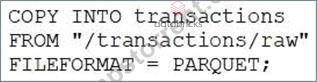
After running the command today, the data engineer notices that the number of records in table transactions has not changed.
Which of the following describes why the statement might not have copied any new records into the table?
- A. The format of the files to be copied were not included with the FORMAT_OPTIONS keyword.
- B. The previous day's file has already been copied into the table.
- C. The names of the files to be copied were not included with the FILES keyword.
- D. The COPY INTO statement requires the table to be refreshed to view the copied rows.
- E. The PARQUET file format does not support COPY INTO.
Answer: B
Explanation:
The COPY INTO statement is an idempotent operation, which means that it will skip any files that have already been loaded into the target table1. This ensures that the data is not duplicated or corrupted by multiple attempts to load the same file. Therefore, if the data engineer runs the same command every day without specifying the names of the files to be copied with the FILES keyword or a glob pattern with the PATTERN keyword, the statement will only copy the first file that matches the source location and ignore the rest. To avoid this problem, the data engineer should either use the FILES or PATTERN keywords to filter the files to be copied based on the date or some other criteria, or delete the files from the source location after they are copied into the table2. References: 1: COPY INTO | Databricks on AWS 2: Get started using COPY INTO to load data | Databricks on AWS
NEW QUESTION # 42
Which of the following data lakehouse features results in improved data quality over a traditional data lake?
- A. A data lakehouse provides storage solutions for structured and unstructured data.
- B. A data lakehouse stores data in open formats.
- C. A data lakehouse allows the use of SQL queries to examine data.
- D. A data lakehouse enables machine learning and artificial Intelligence workloads.
- E. A data lakehouse supports ACID-compliant transactions.
Answer: E
Explanation:
Explanation
One of the key features of a data lakehouse that results in improved data quality over a traditional data lake is its support for ACID (Atomicity, Consistency, Isolation, Durability) transactions. ACID transactions provide data integrity and consistency guarantees, ensuring that operations on the data are reliable and that data is not left in an inconsistent state due to failures or concurrent access. In a traditional data lake, such transactional guarantees are often lacking, making it challenging to maintain data quality, especially in scenarios involving multiple data writes, updates, or complex transformations. A data lakehouse, by offering ACID compliance, helps maintain data quality by providing strong consistency and reliability, which is crucial for data pipelines and analytics.
NEW QUESTION # 43
Which of the following is stored in the Databricks customer's cloud account?
- A. Data
- B. Cluster management metadata
- C. Notebooks
- D. Repos
- E. Databricks web application
Answer: A
Explanation:
The only option that is stored in the Databricks customer's cloud account is data. Data is stored in the customer's cloud storage service, such as AWS S3 or Azure Data Lake Storage. The customer has full control and ownership of their data and can access it directly from their cloud account.
Option A is not correct, as the Databricks web application is hosted and managed by Databricks on their own cloud infrastructure. The customer does not need to install or maintain the web application, but only needs to access it through a web browser.
Option B is not correct, as the cluster management metadata is stored and managed by Databricks on their own cloud infrastructure. The cluster management metadata includes information such as cluster configuration, status, logs, and metrics. The customer can view and manage their clusters through the Databricks web application, but does not have direct access to the cluster management metadata.
Option C is not correct, as the repos are stored and managed by Databricks on their own cloud infrastructure. Repos are version-controlled repositories that store code and data files for Databricks projects. The customer can create and manage their repos through the Databricks web application, but does not have direct access to the repos.
Option E is not correct, as the notebooks are stored and managed by Databricks on their own cloud infrastructure. Notebooks are interactive documents that contain code, text, and visualizations for Databricks workflows. The customer can create and manage their notebooks through the Databricks web application, but does not have direct access to the notebooks.
Reference:
Databricks Architecture
Databricks Data Sources
Databricks Repos
[Databricks Notebooks]
[Databricks Data Engineer Professional Exam Guide]
NEW QUESTION # 44
A data engineer has been using a Databricks SQL dashboard to monitor the cleanliness of the input data to an ELT job. The ELT job has its Databricks SQL query that returns the number of input records containing unexpected NULL values. The data engineer wants their entire team to be notified via a messaging webhook whenever this value reaches 100.
Which of the following approaches can the data engineer use to notify their entire team via a messaging webhook whenever the number of NULL values reaches 100?
- A. They can set up an Alert with a new webhook alert destination.
- B. They can set up an Alert without notifications.
- C. They can set up an Alert with a new email alert destination.
- D. They can set up an Alert with one-time notifications.
- E. They can set up an Alert with a custom template.
Answer: A
NEW QUESTION # 45
Identify the impact of ON VIOLATION DROP ROW and ON VIOLATION FAIL UPDATE for a constraint violation.
A data engineer has created an ETL pipeline using Delta Live table to manage their company travel reimbursement detail, they want to ensure that the if the location details has not been provided by the employee, the pipeline needs to be terminated.
How can the scenario be implemented?
- A. CONSTRAINT valid_location EXPECT (location != NULL) ON DROP ROW
- B. CONSTRAINT valid_location EXPECT (location != NULL) ON VIOLATION FAIL
- C. CONSTRAINT valid_location EXPECT (location = NULL)
- D. CONSTRAINT valid_location EXPECT (location != NULL) ON VIOLATION FAIL UPDATE
Answer: D
NEW QUESTION # 46
......
The Databricks Databricks-Certified-Data-Engineer-Associate exam consists of 60 multiple-choice questions that must be completed in 90 minutes. The passing score for the exam is 70%, and candidates who pass the exam will receive a certificate that validates their knowledge and expertise in Databricks. Databricks Certified Data Engineer Associate Exam certification is recognized globally and is a valuable asset for data engineers who want to advance their careers and demonstrate their proficiency in Databricks.
Download Exam Databricks-Certified-Data-Engineer-Associate Practice Test Questions with 100% Verified Answers: https://troytec.dumpstorrent.com/Databricks-Certified-Data-Engineer-Associate-exam-prep.html