

Verified Ind-Dev-201 dumps Q&As 100% Pass in First Attempt Guaranteed Updated Dump from DumpsTorrent
Pass Salesforce Developers Ind-Dev-201 Exam With 320 Questions
NEW QUESTION # 89
Which of these can you use in a promotion to change the price of a child product? (Choose TWO Note: This question displayedanswer options in random order when taking this Test.
- A. MACD
- B. Different price list
- C. Adjustment
- D. Override
- E. New order
Answer: C,D
Explanation:
To change the price of a child product within a promotion, you can use the following methods:
* Adjustment (B): This refers to applying a price adjustment to the product, either by a fixed amount or a percentage, which modifies the original price based on the terms of the promotion.
* Override (C): This method involves setting a new price that overrides the original price of the product within the context of the promotion.
Both methods allow for flexible pricing strategies within promotions, enabling customized pricing options that can be tailored to specific marketing objectives or customer segments.
NEW QUESTION # 90
Context rules can determine whether a customer is qualified or disqualified for a promotion.
- A. True
- B. False
Answer: A
Explanation:
Context rules in Salesforce Industries CPQ can indeed determine whether a customer is qualified or disqualified for a promotion. This capability is integral to the CPQ process as it ensures that promotions are only applied to customers or orders that meet specific predefined criteria. This qualification/disqualification process is governed by the rules set up in the CPQ configuration, allowing businesses to automate and enforce their promotional policies effectively.
NEW QUESTION # 91
What are the purposes of the CPQPartition platform cache? (Choose TWO)
Note: This question displayed answer options in random order when taking this Test.
- A. Cache local data for browser use
- B. To store a consolidated product attribute list, ensuring good performance during product configuration
- C. To store data for CPQ context rules, increasing the speed of read/write operations
- D. To store a streamlined version of the product hierarchy
Answer: B,D
Explanation:
The purposes of the CPQPartition platform cache in Salesforce Industries CPQ are multifaceted, focusing primarily on enhancing performance and efficiency. The cache stores a streamlined version of the product hierarchy, allowing for faster access and navigation within the CPQ tool, which is crucial during complex configuration processes. Additionally, it consolidates the product attribute list, which ensures good performance by minimizing the overhead needed to fetch these details repeatedly during product configuration sessions. This helps in maintaining a responsive user experience by speeding up read operations and reducing the time taken to load and interact with CPQ data.
NEW QUESTION # 92
Which of the following are the three Configuration/Validation implementations provided by Vlocity?
Note: This question displayed answer options in random order when taking this Test.
- A. DefaultRuleslmplementation
- B. AdvancedCompatibilitylmplementaion
- C. ValidationRuleslmplementation
- D. DefaultProductValidationlmplementation
- E. CustomValidationFramework
- F. ProductRelationshipValidationlmpI
Answer: A,D,F
Explanation:
Salesforce Industries CPQ provides various configuration and validation frameworks to ensure the correct application of product rules and relationships. Among the options listed:
* B. DefaultRulesImplementation - This is a basic validation implementation that applies predefined rules in standard scenarios.
* C. ProductRelationshipValidationImpl - This focuses on validating relationships between products as defined in the CPQ setup, ensuring that product dependencies and compatibilities are respected.
* E. DefaultProductValidationImplementation - This implementation provides default validation for product configurations, ensuring that product selections meet predefined criteria without custom coding.
Options A, D, and F are either mislabeled (misspellings in the options) or not standard parts of Salesforce Industries CPQ as known functionalities.
NEW QUESTION # 93
Asset-based ordering capabilities are powered by which OmniStudio features?
- A. OmniScript and Calculation Matrices
- B. OmniScript and Integration Procedures
- C. FlexCards and OmniScript
- D. Calculation Procedures and Matrices
Answer: C
Explanation:
Asset-based ordering capabilities in Salesforce Industries CPQ are primarily powered by "FlexCards and OmniScript." FlexCards provide a flexible, configurable interface for displaying asset data, while OmniScript facilitates the scripting of interactive processes that manage and guide the user through asset-based ordering activities. Together, these features allow for dynamic and visually rich asset management and ordering processes, supporting complex business logic and user interactions effectively within the CPQ solution.
NEW QUESTION # 94
In Vlocity Context Rules, what value should be entered in the source expression of a context mapping?
Note: This question displayed answer options in randomorder when taking this Test.
- A. %%field%%
- B. The API name of an sObject field
- C. {{field}}
- D. A calculated formula used by the context rule service engine
Answer: A
Explanation:
In Vlocity Context Rules, when creating a source expression in a context mapping, the correct format to reference an sObject field is %%field%%. This format is used within the Vlocity platform to dynamically insert the value of a field from the context into the rule or mapping. This syntax allows the context rule engine to correctly interpret and retrieve the necessary data from the Salesforce object model, ensuring accurate and relevant rule processing based on the current transactional context.
NEW QUESTION # 95
Which type of discount can be used to apply negotiated discounts to customer orders using frame/pricing agreements?
- A. Contract
- B. Group
- C. Account
- D. Order
Answer: A
Explanation:
In Salesforce Industries CPQ, Contract type discounts are typically used to apply negotiated discounts to customer orders under the framework of frame/pricing agreements. These discounts are predefined and are associated with specific contracts or agreement terms between the selling organization and the customer, allowing for the consistent application of agreed-upon pricing concessions across multiple orders or transactions.
NEW QUESTION # 96
Which of these will the user see when they use the Guided Selling interaction? (Choose FOUR) Note: This question displayed answer options in random order when taking this Test.
- A. A way to launch the cart from an account or order
- B. Automatic totaling of products added to the cart
- C. Step-by-step process to recommend and sell products
- D. Ability to change the price book for the cart
- E. Asummary of assets the customer already has purchased
- F. Ability to edit items already placed inthe cart
Answer: A,B,C,F
Explanation:
When users engage with the Guided Selling interaction in Salesforce Industries CPQ, they experience the following features: B. Step-by-step process to recommend and sell products: This is a core functionality of Guided Selling, providing a sequential, interactive process that guides users through the configuration and selling process. C. A way to launch the cart from an account or order: This integration allows users to easily transition from account or order details into the guided selling process with relevant context and data.
D: Automatic totaling of products added to the cart: Automatically calculates totals as products are added or modified in the cart, providing immediate feedback on pricing changes and totals. E. Ability to edit items already placed in the cart: Users have the flexibility to modify product selections directly within the cart during the guided selling process.
These features are designed to streamline the selling experience, ensuring users have a dynamic and responsive interface that supports efficient sales processes.
References:
* Salesforce Industries CPQ User Guide.
* Salesforce training materials on Guided Selling functionalities.
NEW QUESTION # 97
Context mappings can be configured from the context dimension or the context scope.
- A. True
- B. False
Answer: A
Explanation:
Context mappings in Salesforce Industries CPQ can indeed be configured either from the context dimension or the context scope. This dual configurability allows for a more versatile application of context settings, making it possible to adjust mappings based on the specific requirements of dimensions or scopes within the data model. This flexibility is essential for tailoring the system to meet complex business rules and scenarios.
NEW QUESTION # 98
A company wants to charge differentprices for a service depending on the bandwidth and network selected by the customer.
* If bandwidth is 1 GB and network is ''Internet the price is $10/monthly and $5/one-time-charge
* If bandwidth is 10 GB and network is ''external,'' the price is $20/monthly and $0/one-time-charge Which type of pricing should the developer configure to meet these requirements?
- A. Cost and Margin Pricing
- B. Usage Pricing
- C. Attribute Based Pricing
- D. Context rules for pricing adjustments
Answer: C
Explanation:
For the scenario described, where prices vary based on different attributes (bandwidth and network type), the developer should configure Attribute Based Pricing in Salesforce Industries CPQ. This pricing model allows for the setting of prices based on specific attributes selected by the customer. It's particularly useful in scenarios like this where the price needs to dynamically adjust based on a combination of product features or service parameters.
NEW QUESTION # 99
How should the developer configure the products to support theserequirements following best practices?
- A. Create a Color formula field on the Product2 object. Use a function to display different values depending on a product code lookup.
- B. Create Product2 record types for each phone. Create a Color attribute and assign it to the record types.
Create global picklist for each set of possible colors, and assign the picklist to the recordtypes. - C. Create a Color attribute andassign it to an object type. Create products for each phone using the object type, and override the inherited Color attribute's picklist with a custom picklist.
- D. Create an object type for each phone. Create a Color attribute, and assign it to each of the object types.
On each object type, override the default picklist with custom picklist.
Answer: C
Explanation:
For configuring products to support various colors in a flexible and scalable manner, it's best to create a Color attribute and assign it to an object type. Then, create products for each phone using this object type. By overriding the inherited Color attribute's picklist with a custom picklist for each product, the developer can ensure that each phone model can have its unique set of available colors. This approach leverages Salesforce's object and attribute functionality to maintain clean data structures while allowing for customization at the product level.
NEW QUESTION # 100
A developer create a new bundle with 3 levels of child products, as shown below.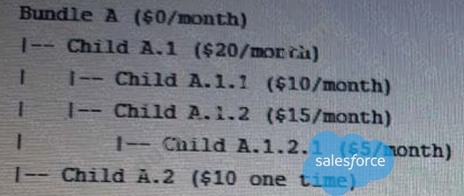
To test the new bundle, the developer adds it to the Cart, but only the parent product displays.
What is causing this issue?
- A. The product hierarchy data in the platform cache has not been refreshed.
- B. The bundle is trying to roll Up monthly prices, andone of the child products has a one-time price.
- C. The bundle's hierarchy exceeds the limit of 2 levels of child products.
- D. One of the child productshas an incorrect Selling Start Date or End Date.
Answer: A
Explanation:
If only the parent product displays when adding a new bundle with multiple levels of child products to the Cart, it's likely that the platform cache has not been refreshed to include recent changes or additions: B. The product hierarchy data in the platform cache has not been refreshed. Refreshing the cache ensures that all the latest data, including hierarchical relationships among the products within a bundle, is up-to-date. This step is crucial especially after adding new products or making structural changes to existing product configurations.
NEW QUESTION # 101
In Guided Selling, which of these is the class for the remote methods?
Note: This question displayed answer options in random order when taking this Test.
- A. checkout
- B. submit
- C. postCartsltems
- D. putCartsltems
- E. createCart
- F. getCartsltems
- G. getCartsProducts
- H. CpqAppHandler
- I. vlcCart
- J. done
Answer: H
Explanation:
In Salesforce Industries CPQ's Guided Selling, CpqAppHandler is the class typically used for remote methods. This class includes functions that are designed to handle complex interactions with the CPQ application, facilitating various backend processes necessary for the CPQ workflow. These remote methods could include anything from managing the cart, handling pricing calculations, to updating product configurations, making it integral to the seamless operation of guided selling scenarios.
NEW QUESTION # 102
What is Vlocity Guided Selling used for? (Choose FOUR)
Note: This question displayed answer options in random order when taking this Test.
For customers and partners who can self-order
- A. To replace the regular Vlocity Cart for order capture
- B. To reduce average call handling time and agent training
- C. To use functions not foundwith the Vlocity Cart for order capture
- D. To provide a better customer experience
- E. To train agents in selling processes before they use the regular Vlocity Cart
- F. To include helpful instructions for agents
Answer: B,D,E,F
Explanation:
Vlocity Guided Selling is used for enhancing the sales process by guiding sales agents or customers through a streamlined, step-by-step sales journey. This tool is instrumental in reducing average call handling times and training requirements for agents (A), improving the overall customer experience by providing a more interactive and directed sales process (B), and including helpful instructions that aid agents during the sales process (F). Additionally, it's used in training environments to prepare agents before they use the regular Vlocity Cart, ensuring they are familiar with the sales processes and system functionalities (E).
References:
* Salesforce Industries CPQ documentation on Guided Selling.
* Training materials for Salesforce Industries CPQ Guided Selling features.
NEW QUESTION # 103
Use the Add Mode and Default Quantity fields only for auto-add or auto-replace product relationships.
- A. True
- B. False
Answer: A
Explanation:
The fields "Add Mode" and "Default Quantity" in Salesforce Industries CPQ are specifically designed to be used for auto-add or auto-replace product relationships. These fields dictate how products are automatically added or replaced in the CPQ configuration, such as adding a mandatory accessory when a main product is selected or replacing an existing product with a new version, ensuring that product configurations remain valid and complete.
NEW QUESTION # 104
What is the minimum amount of space that you should allocate for theCPQPartition?
Note: This question displayed answer options in random order when taking this Test.
- A. 1GB
- B. 0MB, since you can disable the CPQPartition.
- C. 100 MB
- D. 10 MB
Answer: A
Explanation:
For the CPQ Partition in Salesforce CPQ, it is recommended to allocate a minimum of 1GB of space. The CPQ Partition is an important component that handles data processing and storage needs specific to CPQ functionalities. Allocating at least 1GB ensures that there is sufficient space to manage the configuration data, price calculations, and other process-intensive operations that are typical within CPQ workflows. This allocation helps in maintaining performance levels and ensuring that the CPQ system can handle the volume of data typically processed during quoting and pricing calculations efficiently.
NEW QUESTION # 105
Lengthy on-boarding for new hires is a business challenge historically faced by telecommunications companies.
- A. True
- B. False
Answer: A
Explanation:
* A. True: Historically, telecommunications companies have faced the challenge of lengthy onboarding processes for new hires due to the complex nature of the industry and the detailed knowledge required.
This includes understanding diverse service offerings, regulatory requirements, and sophisticated technology platforms.
NEW QUESTION # 106
In order to filter product attributes, the API name of the JSONAttribute field must be specified in the Attribute Lookup Field Name of the Entity Filter.
- A. True
- B. False
Answer: A
Explanation:
For filtering product attributes in Salesforce Industries CPQ using Entity Filters, it is true that the API name of the JSONAttribute field must be specified in the Attribute Lookup Field Name. This is essential because the Entity Filter uses this field name to correctly identify and apply filters to the specific attributes within the product data structured in JSON format.
NEW QUESTION # 107
If you assign a new attribute to an object type, how is that attribute propagated to all products linked to the object type?
Note: This question displayed answer options in random order when taking this Test.
- A. Dynamically through inheritance
- B. Via a deep copy to Product2
- C. By running the EPCProductAttribBatchJob to regenerate the product attribute JSON field
- D. By running the Attribute Hierarchy Maintenance job on the CMT Administration screen
Answer: A
Explanation:
When a new attribute is assigned to an object type in Vlocity, the attribute is propagated to all products linked to that object type dynamically through inheritance. This means that once the attribute is linked to the object type, all product instances that inherit properties from this object type will automatically receive the new attribute. This method ensures consistency across products and simplifies the management of product attributes, as updates need only be made at the object type level rather than individually across products.
NEW QUESTION # 108
Which of the following are the key technologies that power guided selling experience?
- A. Vlocity Order Management
- B. Vlocity CPQ
- C. Vlocity OmniScript
- D. Vlocity Account Manager
Answer: B,C
Explanation:
In the context of Salesforce Industries CPQ (formerly Vlocity CPQ), the key technologies powering a guided selling experience include Vlocity OmniScript and Vlocity CPQ. OmniScript is a tool used to design digital interaction scripts that guide users through processes in a dynamic, data-driven way, suitable for creating complex guided selling flows. Vlocity CPQ is specifically tailored for configuration, pricing, and quoting processes, essential for a guided selling experience that requires dynamic pricing models and product configurations.
NEW QUESTION # 109
......
Pass Ind-Dev-201 Tests Engine pdf - All Free Dumps: https://troytec.dumpstorrent.com/Ind-Dev-201-exam-prep.html